
Japan Joins Trump's Circle, Prepared to Counter Russian-Chinese Ambitions
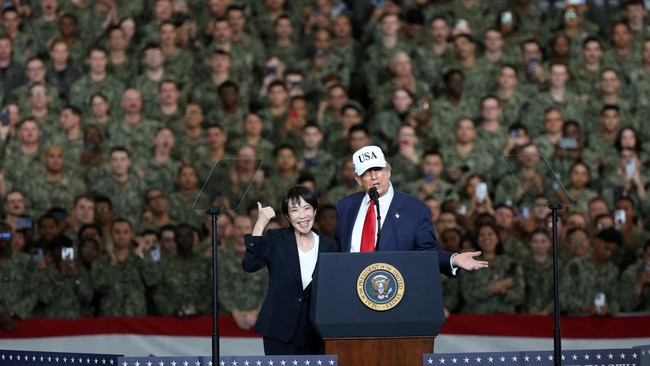
Tokyo, Indonesia – Japanese Prime Minister Sanae Takaichi is expected to announce Tokyo’s formal participation in the United States’ missile defence system known as “Golden Dome” during meetings with President Donald Trump next week. This major step marks a new chapter in the bilateral defence alliance amid rising tensions across East Asia.
The system, promoted as a next-generation missile defence shield, is designed to protect the region from increasingly sophisticated air threats. Pentagon Chief Pete Hegseth stated last year that Golden Dome would progressively protect the nation from air attacks from any enemy, including through space-based interceptors and sensors.
According to Japan’s Yomiuri newspaper, citing unnamed government sources, Takaichi is scheduled to discuss the initiative with Trump during their planned meeting on 19 March in Washington. “During that meeting, Takaichi will directly convey Japan’s intention to participate in this prestigious project,” the source said, as also reported by the AFP.
The cooperation has strategic objectives for both countries in addressing threats from the latest military technology of their global rivals. The Yomiuri reported that the aim is for the two allies to jointly develop interceptors and satellite networks as a counter-force against hypersonic glide vehicles (HGVs) currently being developed by China and Russia.
The threat from hypersonic weapons has indeed become a serious concern for global defence authorities due to their extraordinary speed. Hypersonic glide vehicles are said to be capable of flying at speeds of at least Mach 5, or five times the speed of sound, making them difficult to detect with conventional defence systems.
Through participation in the Golden Dome initiative, Tokyo hopes to significantly strengthen its own defence fortifications. The Yomiuri reported that by participating in Golden Dome, Japan aims to enhance its own defence capabilities in response to increasingly uncertain security dynamics.
This step is also consistent with Japan’s recent foreign policy shift, gradually moving away from the strict pacifist principles it has adhered to for decades since World War II. Japan has been noted as continuously moving to acquire “strike-back” capabilities and has committed to doubling military spending to two per cent of GDP.
Takaichi’s seriousness in strengthening the military is evident from the substantial budget allocation in the latest national budget. Last December, the government approved a record budget for the upcoming fiscal year starting next month, including a record 9 trillion yen (Rp 950.4 trillion) for defence spending.