
James Webb Telescope Discovers 'Living Fossil' from the Early Universe
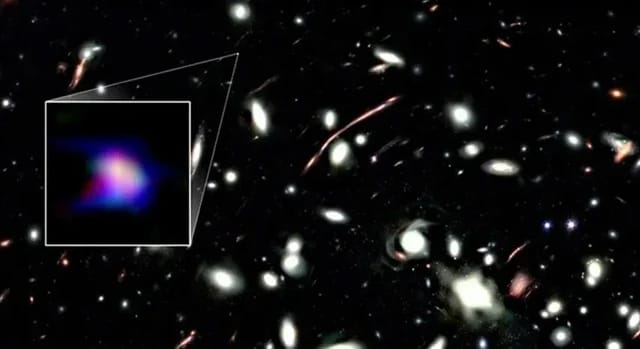
The James Webb Space Telescope (JWST) has once again made history in space exploration. The most advanced instrument built by humanity has successfully detected an ancient galaxy named LAP1-B, a celestial object that existed approximately 800 million years after the Big Bang. The discovery, published in the journal Nature on 13 May, was led by Associate Professor Kimihiko Nakajima of Kanazawa University. LAP1-B has become a focal point of the astronomical world due to its status as the galaxy with the lowest metal content ever detected in the primitive universe. This success proves the superiority of JWST in penetrating the universe’s ‘Dark Ages’, or the Era of Reionisation. During the period between 380,000 and 1 billion years after the Big Bang, the universe was dominated by neutral hydrogen that absorbed visible light, meaning objects within it could only be detected through the infrared spectrum. With the aid of gravitational lensing, where a massive galaxy cluster acts as a natural lens, the faint light from LAP1-B was amplified up to 100 times. This allowed the research team to conduct a deep spectroscopic analysis over more than 30 hours of observation. In astronomy, the term ‘metal’ refers to all elements heavier than hydrogen and helium. The finding that LAP1-B has an extremely low oxygen content indicates that the galaxy is still in a ‘pristine’ condition and has not yet been heavily contaminated by supernova explosions from subsequent stellar generations. The carbon-to-oxygen ratio in LAP1-B is highly identical to predictions of matter produced by Cluster III stars, the first generation of stars that triggered the formation of elements vital for life, such as carbon and nitrogen. This discovery provides physical evidence that, until now, had only been theoretical among scientists. ‘It is like directly witnessing the history of the universe that happened 13 billion years ago, no longer just theorising through the traces left behind,’ said Nakajima in his statement. In addition to its chemical composition, the extremely small stellar mass of LAP1-B indicates that this galaxy is likely dominated by a dark matter halo. This characteristic leads to LAP1-B being considered a ‘living fossil’ that bears similarities to the ultra-faint dwarf galaxies (UFDs) found around the Milky Way. Professor Masami Ouchi added that this finding serves as an important bridge connecting primordial galaxies with galactic remnants that still exist today. With James Webb’s technology, the veil of mystery regarding how the first stars and galaxies formed is now beginning to be lifted in earnest.