
Jambi Governor Presents Spatial Planning Policy at DPD RI Dissemination Event
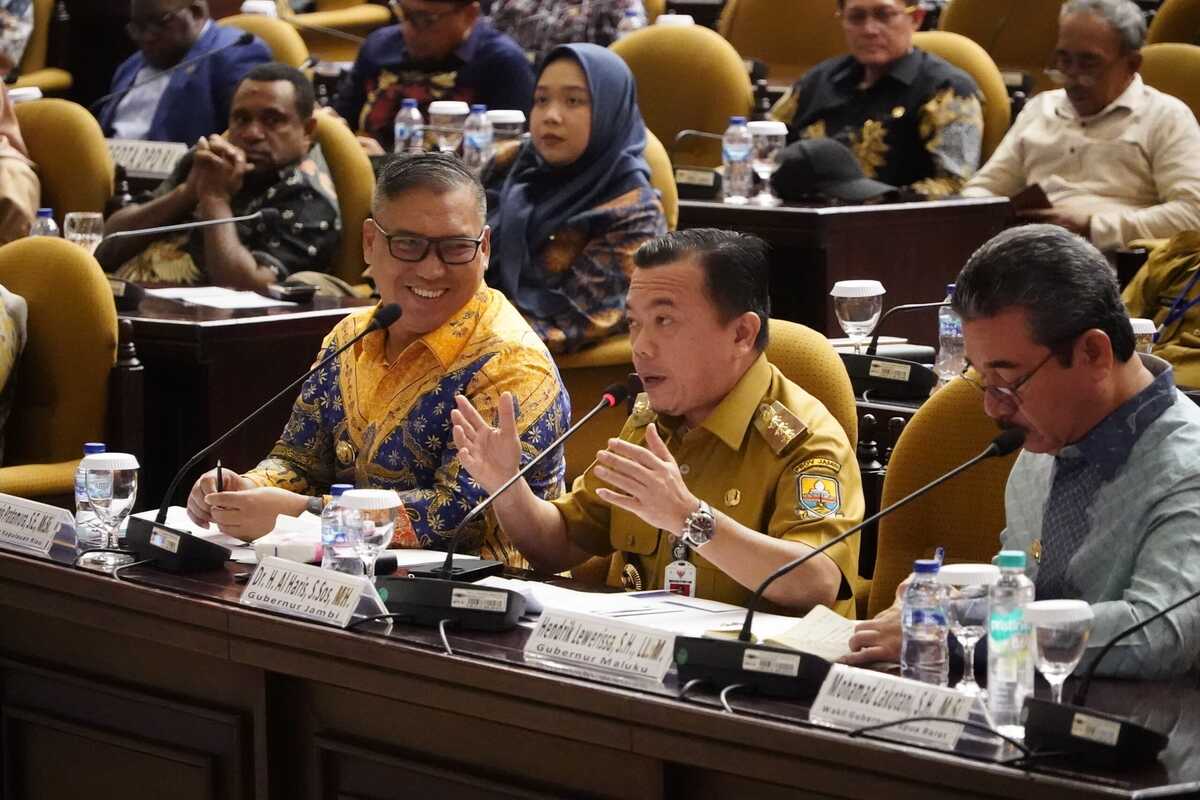
Jambi Governor Al Haris followed up with a presentation on DPD RI Decision Number 53/DPDRI/V/2020-2021 regarding the DPD RI’s recommendations on the monitoring and evaluation of Regional Regulation Drafts and Regional Regulations related to the implementation of Law Number 11 of 2020 on Job Creation, specifically concerning regional spatial planning policies.
The presentation was delivered at the DPD RI’s BULD (Regional Legislation Affairs Body) Dissemination event, held at the Nusantara V Building in the Senayan Parliamentary Complex, Central Jakarta, on Monday (14/07/2025). The dissemination event was opened by the Chairman of the Regional Representative Council of the Republic of Indonesia, Sultan B. Najamudin, and attended by leadership figures, governors from across Indonesia, and other invited guests.
In his presentation, Governor Al Haris stated that spatial planning, which constitutes a primary mandate in the implementation of the Job Creation Law as part of improving the investment climate and business activities, means that updating Spatial Plans has become an urgent necessity in supporting business licensing through the OSS-RBA system.
“The implementation of spatial planning and utilisation must be synergistic between the central and regional governments and must refer to valid geospatial data,” Governor Al Haris explained.
Governor Al Haris noted that currently 463 regencies/cities and specific regions have enacted regional regulations. Meanwhile, of the total 649 Detailed Spatial Plans (RDTR) under the Regional Spatial Plans (RTRW), 367 RDTR have been integrated into the OSS-RBA system.
“Jambi Province enacted its RTRW Regional Regulation in 2023 and was the seventh fastest province nationally to do so,” said Governor Al Haris.
In his presentation, Governor Al Haris expressed hope for a revision of Government Regulation Number 21 of 2021 on spatial planning implementation, calling for consideration of granting more flexible authority and room for innovation to regional governments, with the following expectations:
The Central Government should allocate high-resolution satellite imagery nationally to support the acceleration of spatial planning activities in the regions.
Strengthening human resource capacity in the regions should be a priority through technical training programmes such as GIS and thematic mapping, as well as direct assistance from the central government, including integration of the OSS-RTR system.
There is a need for incentive and disincentive mechanisms for regions that have or have not yet prepared their RTRW and integrated them into the OSS-RTR system.
“We, the Provincial Government, fully support the spirit of spatial planning reform, but there is a need to strengthen central-regional synergy, particularly in funding, authority, and the acceleration of spatial planning documents,” concluded Governor Al Haris, who also serves as Chairman of APPSI (Association of Provincial Governments of Indonesia).
Meanwhile, DPD RI Chairman Sultan B. Najamudin said that the Central Government has been driving large-scale transformation through regulatory simplification and debureaucratisation in order to encourage investment, increase downstream processing capacity for natural and mineral resources, and advance special economic zones.
“Regulations related to spatial planning form the backbone of the government’s agenda, so that the shared aspirations we champion can be achieved,” he said.