
Jala PRT's Notes on the Newly Passed PPRT Law, Acknowledging It Is Not Yet Ideal
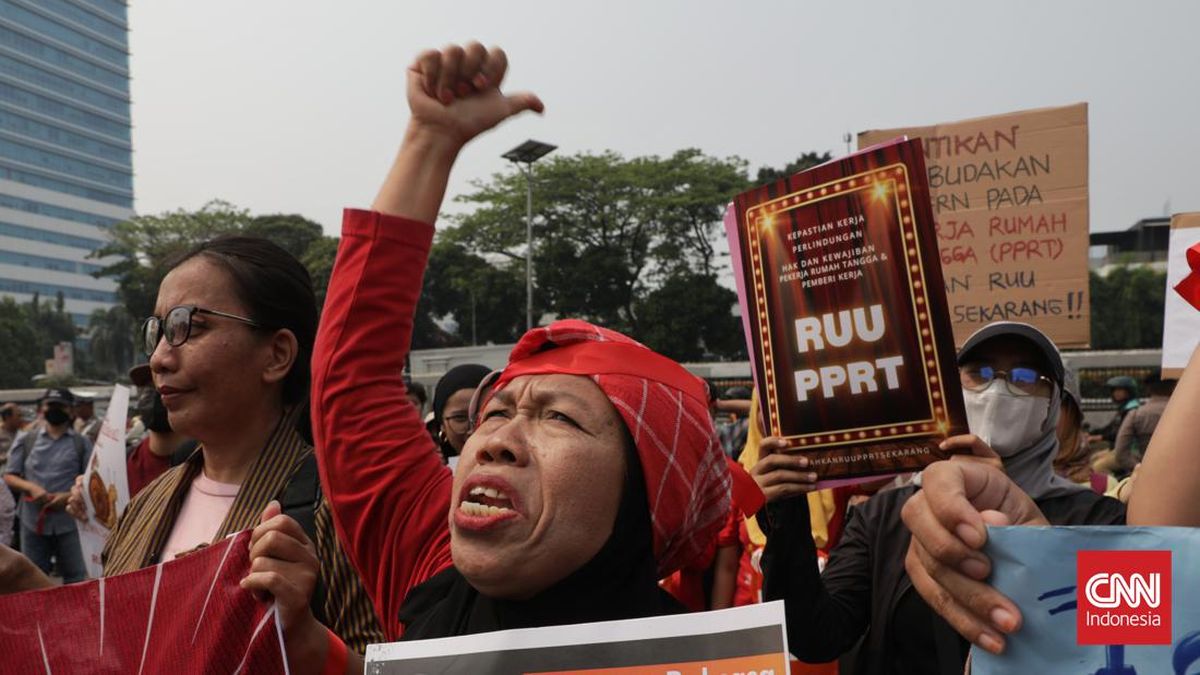
The National Network for Domestic Workers Advocacy (Jala PRT) acknowledges that several provisions in the Domestic Workers Protection Law (UU PPRT), officially passed on Tuesday (21/4), are not yet ideal.
Jala PRT Coordinator, Lita Anggraini, does not deny that several provisions in the law do not explicitly regulate the relationship between domestic workers (PRT) and employers.
However, Lita expresses gratitude that the UU PPRT has finally been passed after its process stalled for 22 years in the DPR.
“So this is, what do you call it, it’s become law even though it’s not ideal and as we first proposed, but at least it refers to the ILO Convention,” said Lita when contacted on Wednesday (22/4).
The UU PPRT was passed in the 17th plenary session closing the IV 2025-2026 session period, after several meetings since early 2026. However, the DPR and government only needed one day to complete the discussion of the PPRT Bill at the first level since receiving the Presidential Letter (Surpres) on 15 April.
“Alhamdulillah, after 22 years of struggle, today the UU PPRT has been passed. This is a historic milestone for friends working in the domestic sector,” said DPR Speaker Puan Maharani in her speech.
Jala PRT’s Notes
Jala PRT, which was involved in several discussion meetings, states that the UU PPRT has adopted 75 percent of the working standards according to ILO Convention 189, which regulates the decency of domestic workers.
Nevertheless, on the other hand, Lita acknowledges that the UU PPRT does not explicitly regulate several rights of domestic workers, from leave rights, working hours, holiday allowances, to social security.
Article 15 of the UU PPRT actually regulates 14 rights obtained by domestic workers, starting from leave, working hours, to social security, both health and employment. However, according to Lita, several of those norms are not yet explicitly regulated.
“There are some that are still not definitive in terms of employment norms like wages, um, working hours, yes, limits on working hours, then weekly holidays, yes,” she said.
For example, although domestic workers are entitled to leave, decent working hours, rest time, and holiday allowances, the UU PPRT does not regulate them in detail. All those rights are given based on agreements between workers and employers.
She also highlighted the use of the phrase ‘based on agreement’ in several provisions, especially those regulating workers’ rights in Article 15.
“PRT is entitled to: d. obtaining Leave in accordance with the Agreement or Employment Contract; e. obtaining Wages in accordance with the Agreement or Employment Contract; f. obtaining religious holiday allowances in the form of money in accordance with the Agreement or Employment Contract,” reads Article 15.
Lita acknowledges that this is a challenge in the Bill. However, her side still appreciates the steps taken by the DPR. According to her, the UU PPRT still needs improvement in the future.
However, that goal will take time. Lita said that Jala PRT will next oversee the preparation of derivative regulations for the UU PPRT, both through government regulations and ministerial regulations.
According to Lita, her side will also create guidelines to serve as a reference so that domestic workers still receive their rights according to the law even if not explicitly regulated.
“For working hours and rest, we will form a campaign team to socialise what the working hours should be like, the rest that should be. So outside of what’s written in the agreement, we Jala PRT will make guidelines,” said Lita.
“There are still shortcomings, but this is what you call it, the law will grow and this is a new chapter towards the next chapters,” she added.