
Jakarta West KPKP Sub-Division inspects sacrificial meat at 121 slaughter sites
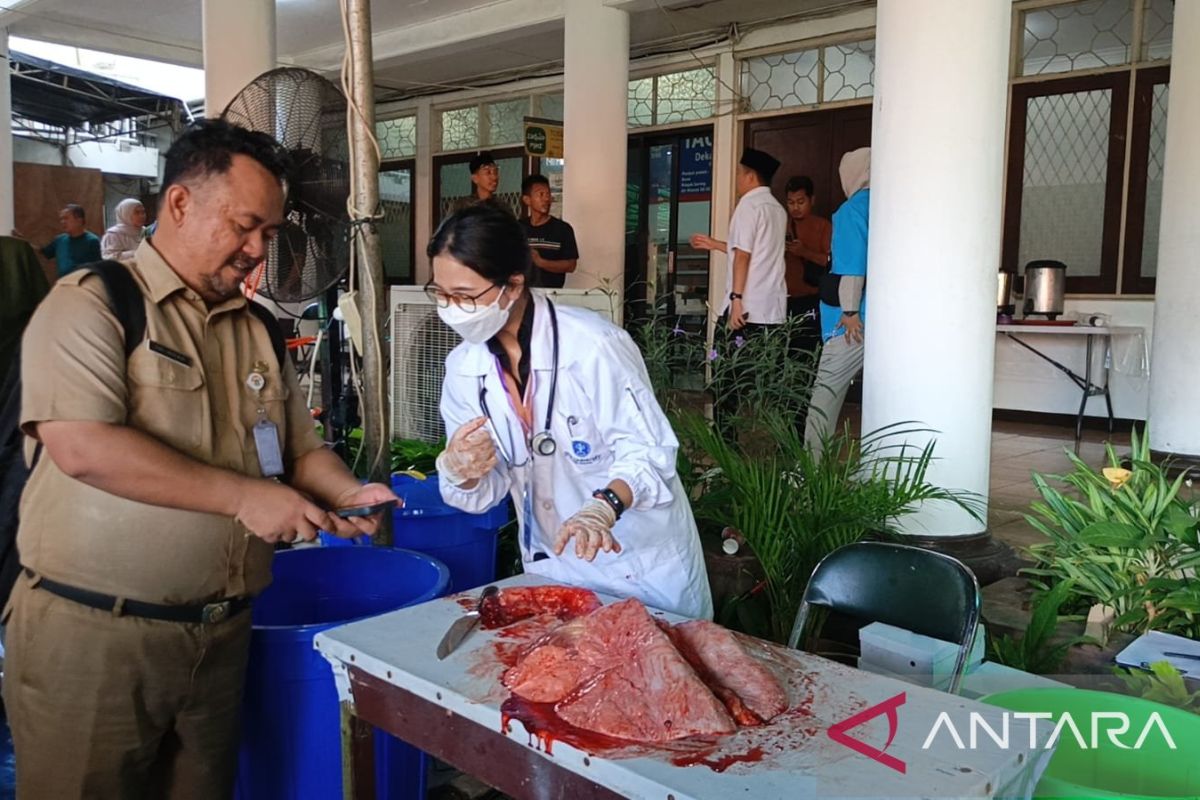
The Jakarta West KPKP Sub-Division conducted checks on sacrificial meat from 121 slaughter sites during Idul Adha on Wednesday.
One inspection took place at Masjid At-Taqwa in Kemanggisan, Palmerah District, West Jakarta.
Bety Rohmawati, head of the Jakarta West KPKP Sub-Division, stated the checks aim to ensure meat distributed to the public is safe and fit for consumption.
“We collaborated with IPB University’s School of Veterinary Medicine and Biomedicine, the Indonesian Veterinary Medical Association, and the Saka Taruna Bumi Scout unit,” Bety said at Masjid At-Taqwa.
Bety explained the current checks are post-mortem examinations, conducted after slaughter.
“A total of 146 officers conducted checks today across 121 slaughter sites,” she added.
Inspectors checked the meat and internal organs including liver, heart, lungs, and spleen.
This is crucial to detect diseases that could threaten human health, Bety said.
“Healthy meat should be fresh red and not watery. For organs, we watch for diseases like liver fluke (Fasciola hepatica), which can damage liver tissue,” she added.
Organs showing signs of disease are not recommended for consumption and must be discarded to ensure food safety.
Bety noted that signs of liver fluke were frequently found in sacrificial animals deemed unsafe for consumption.
“Yes, sometimes found. For instance, cows may appear thin with rough coats. Upon inspection, worms are visible, or lungs may have black spots due to exposure to vehicle pollution,” she added.
Syarifuddin Yahya, chairman of Masjid At-Taqwa’s Kurban committee, said around 1,500 meat packages will be distributed to the public.
“Distribution covers residents from Kemanggisan to Tanjung Duren, using a ring one to three system,” he said.
At the same location, Palmerah District Head Febriandi Suharto said the slaughter process proceeded orderly under KPKP supervision.
He added that the oversight ensures all slaughter and distribution processes meet health standards, benefiting the community.
“We thank those who donated animals and KPKP staff for inspections, ensuring safe meat for recipients,” Febri said.