
Jakarta Stocks Close Down Nearly 2% After MSCI May Review
Jakarta Stocks Close Down Nearly 2% After MSCI May Review
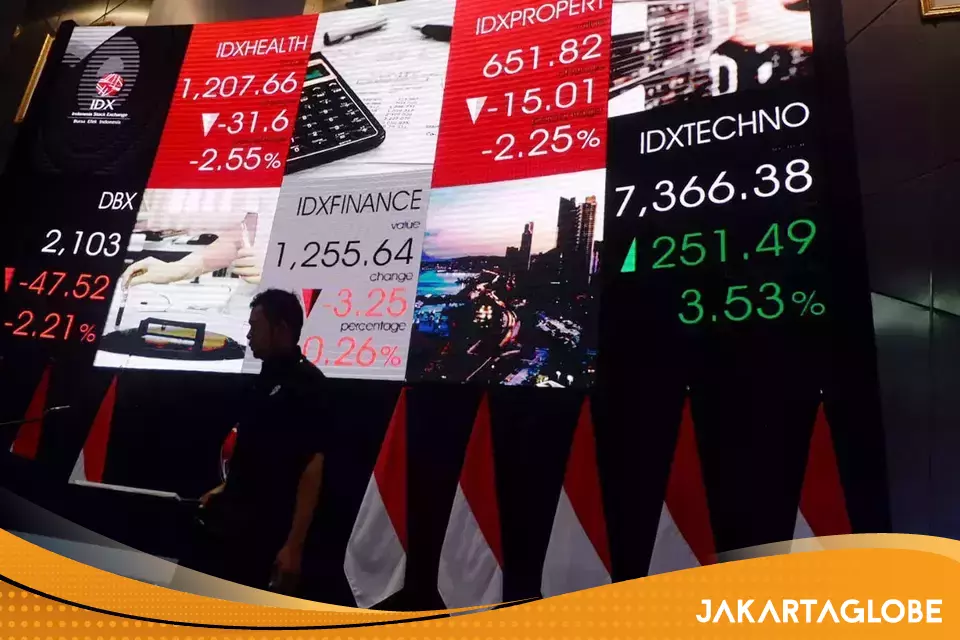
Jakarta. Indonesian stocks tumbled nearly 2% in Wednesday closing as investors reacted to hotter-than-expected US inflation, renewed geopolitical tensions in the Middle East, and concerns over potential foreign fund outflows following MSCI’s latest index rebalancing.
Jakarta Composite Index (JCI) fell 1.98%, or 135 points, to 6,763 by midday trading, moving within a range of 6,705 to 6,787.
Trading volume reached 38.7 billion shares with turnover amounting to Rp 19.78 trillion ($1.13 billion) across more than 2.3 million transactions. Declining stocks outnumbered gainers 416 to 239, while 163 stocks were unchanged.
Pilarmas Investindo Sekuritas said market sentiment was pressured by rising expectations that the Federal Reserve would keep interest rates higher for longer after US inflation accelerated above market expectations.
“US inflation rose from 3.3% to 3.8% year-on-year and exceeded market consensus. This strengthens expectations that the Fed will likely maintain higher interest rates for a longer period,” Pilarmas wrote in its research note on Wednesday.
The brokerage also said investors remained cautious over escalating tensions in the Middle East, which have pushed global oil prices higher and fueled concerns over broader inflationary pressures.
Markets are also closely watching the meeting between US President Donald Trump and Chinese President Xi Jinping scheduled for May 14-15 in Beijing.
According to Pilarmas, discussions are expected to focus on trade relations and the continuation of the tariff truce between the US and China, although investors are also monitoring possible talks surrounding Iran and wider geopolitical risks.
Domestically, sentiment weakened further after MSCI’s May 2026 index review reduced Indonesia’s weight in the MSCI Emerging Markets Index, sparking concerns over capital outflows.
“Markets responded negatively to the reduction in Indonesia’s weighting in the MSCI Emerging Markets Index, which triggered concerns over foreign capital outflows from the domestic financial market,” Pilarmas said.
Responding to the market decline, Financial Services Authority (OJK) Capital Market Supervisor Hasan Fawzi said the correction remained within a normal range and did not reflect panic selling.
“As of around 10 a.m., the decline was confirmed, but market activity remains within what we consider a reasonable range. The correction is still within normal limits,” Hasan said during a press conference at the Indonesia Stock Exchange building in Jakarta.
Hasan added that stocks removed from MSCI indices had not hit auto-rejection lower limits, indicating that selling pressure remained manageable.
The MSCI review included the removal of several major Indonesian stocks from the MSCI Global Standard Index, including:
Amman Mineral Internasional (AMMN)
Chandra Asri Pacific (TPIA)
Dian Swastatika Sentosa (DSSA)
Petrindo Jaya Kreasi (CUAN)
Barito Renewables Energy (BREN)
Sumber Alfaria Trijaya (AMRT)
Meanwhile, stocks removed from the MSCI Global Small Cap Index included:
Aneka Tambang (ANTM)
Astra Agro Lestari (AALI)
Bank Aladin Syariah (BANK)
Bumi Serpong Damai (BSDE)
Dharma Satya Nusantara (DSNG)
Industri Jamu dan Farmasi Sido Muncul (SIDO)
Midi Utama Indonesia (MIDI)
Mitra Keluarga Karyasehat (MIKA)
MNC Digital Entertainment (MSIN)
Pabrik Kertas Tjiwi Kimia (TKIM)
Pacific Strategic Financial (APIC)
Sawit Sumbermas Sarana (SSMS)
Triputra Agro Persada (TAPG)
MSCI also shifted AMRT from the MSCI Global Standard Index to the MSCI Global Small Cap Index as part of its May 2026 review.
Hasan said transaction frequency, trading volume, and market value remained relatively stable compared to previous sessions.
“This shows there has been no panic selling or one-way selling pressure without balancing buying interest,” he said.
The rupiah’s depreciation against the US dollar also added pressure to sentiment, with investors worried that a weaker currency could increase the government’s energy subsidy burden and widen fiscal risks.
Across Asia, markets traded mixed on Wednesday as fading enthusiasm surrounding artificial intelligence and technology stocks slowed Wall Street’s recent rally.
Japan’s benchmark Nikkei 225 rose 0.8% to 63,244 in afternoon trading, while South Korea’s KOSPI jumped 2.7% to 7,849, recovering from losses earlier this week.
Hong Kong’s Hang Seng Index slipped less than 0.1% to 26,335, while China’s Shanghai Composite gained 0.6% to 4,240.
On Wall Street overnight, the S&P 500 fell 0.2% from its record high, while the Dow Jones Industrial Average added 56 points, or 0.1%. The Nasdaq Composite declined 0.7% from its own all-time high.
Tags: Keywords: