
Jakarta Provincial Government Optimises Technology and AI in City Governance
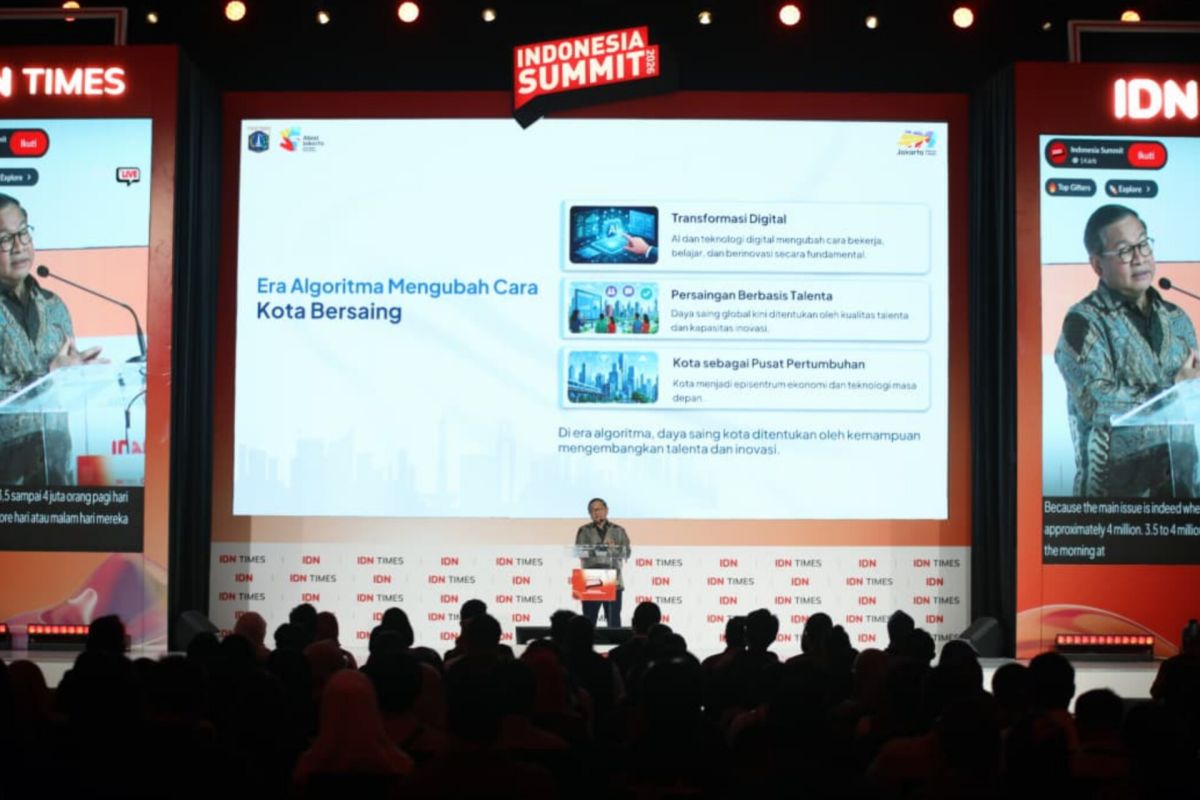
Jakarta - The Jakarta Provincial Government is optimising the use of digital technology, data, and artificial intelligence (AI) in urban governance as part of Jakarta’s transformation into a competitive, inclusive, and sustainable global city.
“Data, digital technology, and AI are now crucial factors in determining the competitiveness of a nation and its cities. As the national economic centre, Jakarta has a responsibility to drive this transformation,” said Jakarta Governor Pramono Anung.
Speaking at the Indonesia Summit 2026, “The Next Us: Indonesia’s Leap in the Algorithmic Age” in South Jakarta on Thursday, Pramono stated that a city’s competitiveness in the algorithmic era no longer relies solely on physical infrastructure development.
A city must also be capable of preparing talent, encouraging innovation, and utilising technology to strengthen public services and policy effectiveness. “Therefore, the Jakarta Provincial Government continues to push for Jakarta to become an increasingly competitive, inclusive, and sustainable global city,” Pramono added.
Furthermore, he noted that Jakarta’s position as a global city is showing a positive trend. According to the Global City Index, Jakarta’s ranking has risen from 74th to 71st.
This achievement, he said, serves as a stepping stone to strengthen Jakarta’s competitiveness towards the target of reaching the top 20 global cities by 2045. To achieve this target, the Jakarta Provincial Government is preparing the Jakarta RISE#20 initiative as a framework for the transformation towards a global city.
This initiative serves as a reference to ensure that development programmes, service innovations, and the strengthening of Jakarta’s competitiveness are more directed. “This initiative functions as a roadmap to strengthen the foundations of development, encourage innovative and inclusive growth, and enhance Jakarta’s role at both regional and global levels,” Pramono explained.
On the other hand, Pramono outlined that the implementation of technology is being carried out gradually in sectors that directly touch the needs of citizens, ranging from mobility, public services, and spatial data management to strengthening the local economy and the Regional Inflation Control Team (TPID).
Additionally, the use of technology and AI is being applied in urban governance through systems such as the Intelligent Traffic Control System, JAKI, Jakarta Satu, the digitalisation of traditional markets and MSMEs, as well as the use of technology by the TPID to maintain price stability and Jakarta’s inflation, which was recorded at 2.49 per cent annually in May 2026.
In the field of flood mitigation, the Jakarta Provincial Government is optimising the use of CCTV cameras connected to the Jakarta Department of Communication, Informatics, and Statistics. This system can be monitored by the public via the official website www.pantaubanjir.com and serves as part of the support for field-based decision-making.
“This integrated system serves as the backbone for the Water Resources Department’s command centre to make fast and accurate decisions regarding the operation of floodgates and pumps in real-time, especially when the capital enters the rainy season alert status,” Pramono revealed.
Beyond technological strengthening, he emphasised that Jakarta’s transformation must also ensure increasingly inclusive access to public services. In the transport sector, he added, Jakarta’s public transport connectivity has now reached 93 per cent and continues to be developed to be more accessible for people with disabilities, the elderly, and vulnerable groups.
“Modes such as the MRT and Transjakarta continue to be developed to be friendly to people with disabilities and the elderly,” Pramono concluded.