
Jakarta Healthcare Workers' Salaries Reported Unchanged for a Decade, Pramono Responds
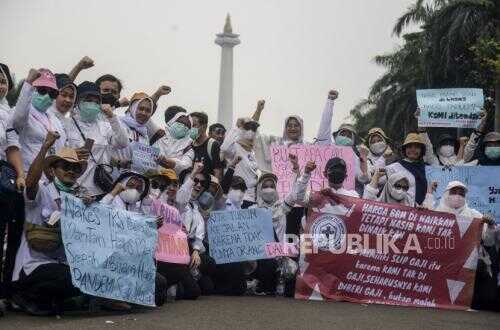
JAKARTA – Healthcare workers (nakes) in Jakarta have reportedly not experienced any salary increases over the past 10 years, according to remarks made by Justin Adrian Untayana, Secretary of Commission E of the Jakarta Provincial Legislative Council, during a working session on Monday, 2 March 2026.
Jakarta Governor Pramono Anung stated that healthcare workers employed as contract-based government employees (PPPK) already receive higher salaries compared to those working in the majority of private hospitals in Jakarta. He emphasised that salaries for civil servants (ASN) will certainly increase according to applicable regulations.
“The salaries of healthcare workers in Jakarta, particularly those with PPPK status, are actually already higher than what private hospitals in Jakarta offer, with the exception of Pondok Indah,” he said at Sarinah. “If salaries never increased, that would be impossible because everything must increase. However, for clarity, I will study this matter further.”
Pramono expressed scepticism about claims that healthcare workers’ salaries have stagnated for a decade. He suggested such information was questionable, as automatic salary adjustments should apply to all government employees.
Earlier, Untayana raised concerns about the heavy workload, occupational risks, and rising cost of living facing healthcare workers. He revealed that some healthcare workers in Jakarta have not received salary increases for 10 years.
“In today’s session, I again pressed the Jakarta Provincial Government to increase salaries for healthcare workers who have gone 10 years without a raise,” he said.
Citing the Sustainable Development Goals (SDG) which recommend a ratio of 4.45 healthcare workers per 1,000 residents, Untayana highlighted that Jakarta’s ratio stands at only 1.73 per 1,000 residents. This means healthcare workers in Jakarta face significantly heavier workloads.
“This ratio does not even account for residents from outside Jakarta who hold the Health Indonesia Card (KIS). If included, the number of healthcare workers serving approximately 13 to 14 million residents in Jakarta becomes even more stretched,” he explained.
Untayana also noted that healthcare workers’ salaries have been eroded by inflation, which has driven up the cost of basic necessities. According to his calculations, prices for essential goods have risen by 36 per cent over the past 10 years, whilst healthcare worker salaries remain unchanged.
“Healthcare workers cannot wait to meet their living expenses. This cannot be delayed any further,” he stressed.
Consequently, Untayana called on Governor Pramono to promptly adjust healthcare workers’ salaries, expressing confidence that the Jakarta Provincial Government is well-positioned to address this issue.