
Jakarta Barat City Government Tackles Drainage Blockage in Kalideres
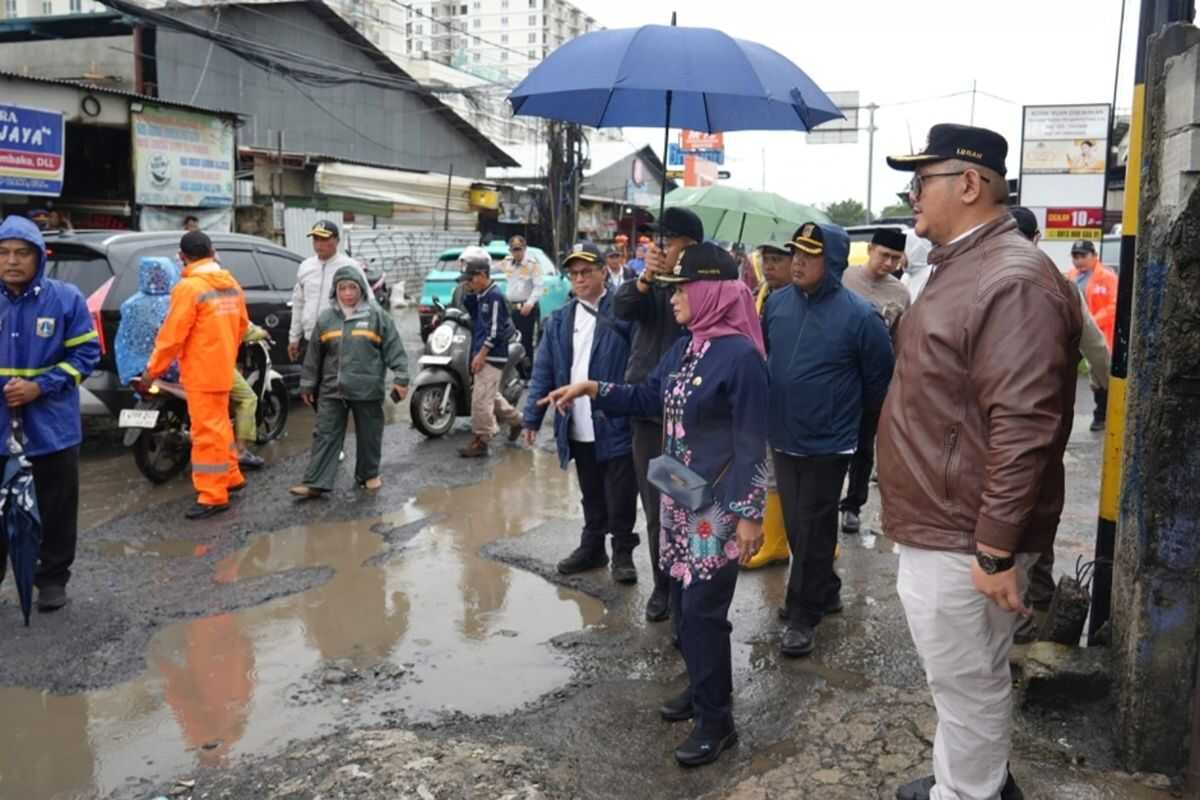
Jakarta (ANTARA) - The West Jakarta City Government (Pemkot Jakbar) has finally addressed the blockage in the drainage system in the Pegadungan area, Kalideres, West Jakarta.
‘Integrated team from the Sudin SDA (Suku Dinas Sumber Daya Air), Sudin Bina Marga, PPSU (Petugas Penanganan Prasarana dan Sarana Umum), and PAM Jaya are still carrying out mass pumping operations to normalise the drainage function,’ said West Jakarta Mayor Iin Mutmainnah in Jakarta on Friday.
Iin said the pumping aims to lift blocks of sediment and odorous mud so that water can flow normally and does not overflow onto the streets in the area.
‘There are also piles of rubbish and very thick sedimentation in the water channel that runs across five RW areas in Pegadungan. Moreover, the road contour (Jalan Peta Selatan) is depressed, so water is prone to becoming trapped,’ she said.
The authorities have prepared a long-term plan: after the piping project (PAM Jaya) is completed, the road surface that is depressed will be raised so that the elevation is even and ponding is eliminated.
Earlier, PAM Jaya denied allegations that the trenching project on Jalan Peta Selatan, Kalideres, West Jakarta had stalled due to lack of physical work.
Senior Manager Corporate & Customer Communication PAM Jaya, Gatra Vaganza, said the lack of physical work at the trench site was due to the method used, namely the ‘jacking’ or underground boring method.
‘Because we are pushing the pipes using the ’jacking’ method. As Jakarta already bans the open-cut method, which would involve cutting along the entire road,’ Gatra said when contacted in Jakarta on Wednesday (4/3).
Pipe jacking is a method of underground construction that installs pipes without trenching by pushing precast pipes from one shaft to another using a hydraulic jack. This method is highly efficient for installing utilities, water, or drainage in densely populated areas without damaging surfaces.
‘So the trench is to check that the pipes passing underground are on the right path. If we pass there, it may look like no work is being done. There is no work on top because it is for monitoring,’ Gatra added.
Gatra emphasised that using the open-cut method would require tearing up the road along the work line, which would massively disrupt traffic.
‘If we used open-cut, for example, to install a pipe from Monas to Bundaran HI, it would involve extensive road demolition and severe traffic congestion,’ he said.
Conversely, he noted, the ‘jacking’ method requires only specific pits to push and monitor the pipe installation from one end to the other underground.
‘Those pits are really to see whether the pipes are straight. People passing by might get the impression ’there are holes but no work being done’. There is no above-ground work because it is for monitoring,’ he added.