
Jakarta and South Sumatra Information Commissions Discuss Strategies for Enhancing Public Information Disclosure Compliance
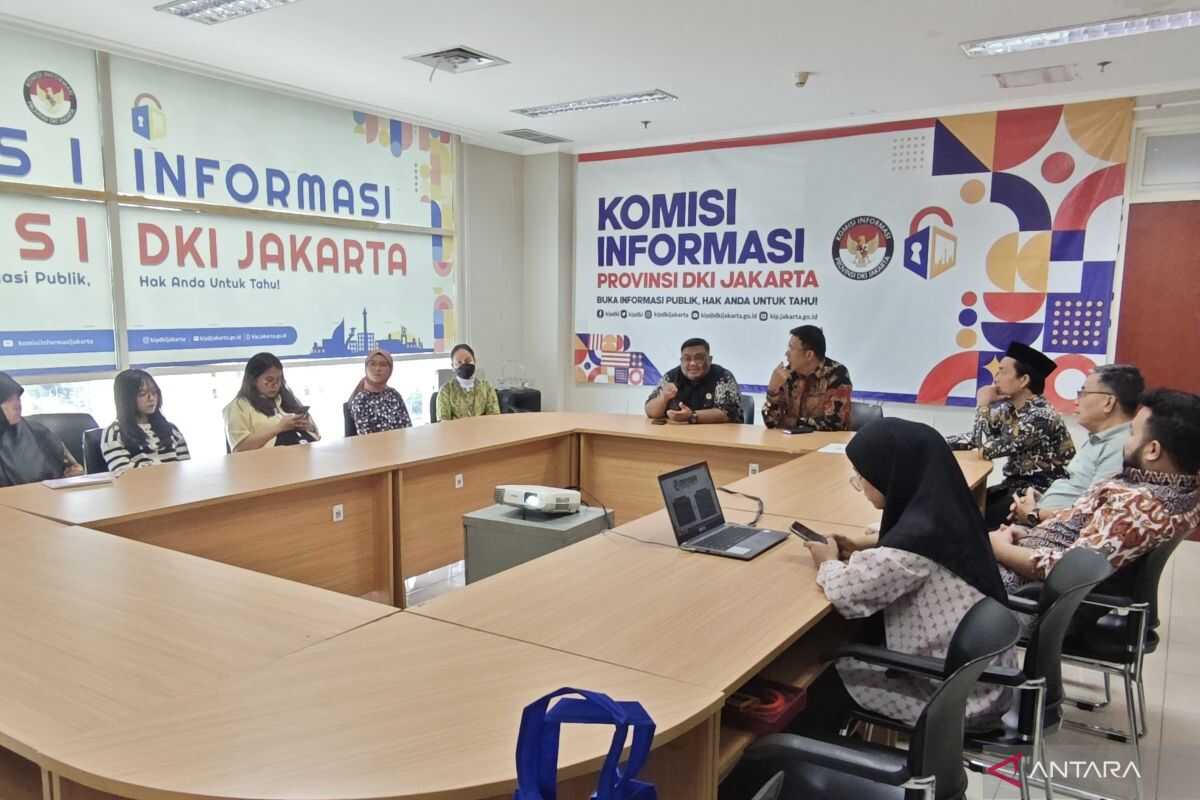
Jakarta (ANTARA) - The Jakarta and South Sumatra Information Commissions shared best practices and discussed strategies for improving public bodies’ compliance with the Public Information Disclosure Law.
The Head of the Information Dispute Resolution Division of the Jakarta Information Commission, Agus Wijayanto Nugroho, welcomed the delegation and emphasized the importance of synergy between information commissions in strengthening the implementation of public information disclosure.
“We always welcome visits and discussions between information commissions as a forum for sharing experiences in strengthening the governance of information disclosure,” said Agus in a statement in Jakarta, Thursday.
During the meeting, the Chairman of the South Sumatra Information Commission, Joemarthine Chandra, explained that the implementation of the 2025 E-Monev in South Sumatra still faces several challenges, especially budget constraints.
He said that currently, the E-Monev in South Sumatra covers 318 public bodies from 12 categories, including district/city governments, regional government organizations (OPDs), vertical agencies, regional-owned enterprises (BUMDs), state-owned enterprises (BUMNs), regional offices of the Ministry of Religion, the Election Supervisory Body (Bawaslu), the General Election Commission (KPU), and high school/vocational schools that are still in the recommendation stage.
“The results of the E-Monev show that many public bodies are not yet informative. The number of public bodies in the quite informative, towards informative, and informative categories is only 49. Therefore, continuous coaching and improvement are still very necessary,” he said.
In response, Agus Wijayanto Nugroho explained that the Jakarta Information Commission has started implementing a digital-based E-Monev application since 2024.
Previously, the evaluation process was still carried out manually using an Excel-based system that adopted the model from the Central Information Commission.
“The implementation of E-Monev aims to ensure that all evaluation documentation is well-systematized and can be accessed by the public in a transparent manner,” explained Agus.
Agus added that the E-Monev methodology implemented by the Jakarta Information Commission was developed independently with a broader scope.
“We have a different methodology from the Central Information Commission. In 2025, E-Monev will target 22 categories with a total of 829 public bodies. This year, we also added the philanthropy category, although it still needs to be strengthened,” he said.
He added that the Jakarta Information Commission plans to build an independent server in 2026 that is integrated with the Public Information and Documentation Officer (PPID) of the Jakarta Provincial Government to strengthen the system for managing and accessing public information.
Regarding visitations, Agus explained that in Jakarta, visitations to public bodies are carried out as part of the monitoring process, not direct assessment, and are scheduled every Monday and Thursday.
“The results of the 2025 E-Monev will be the basis for preparing recommendations for improvement for public bodies in the current year. During the visitation, we ensure that these recommendations are understood and followed up,” he said.
In addition to strengthening E-Monev, the Jakarta Information Commission also emphasizes collaboration with various stakeholders, including regional-owned enterprises (BUMDs), while maintaining institutional integrity.
The meeting also discussed the concept of an informative zone, namely the designation of informative public bodies within a certain period, which is marked by the installation of a sign as a form of recognition and public control.
In the future, the Jakarta Information Commission also proposes involving the public in assessing public information services as a form of active public participation in encouraging transparency and accountability of public bodies.