
ITB Students Design Smart Helmet to Detect Drowsiness in Motorcyclists
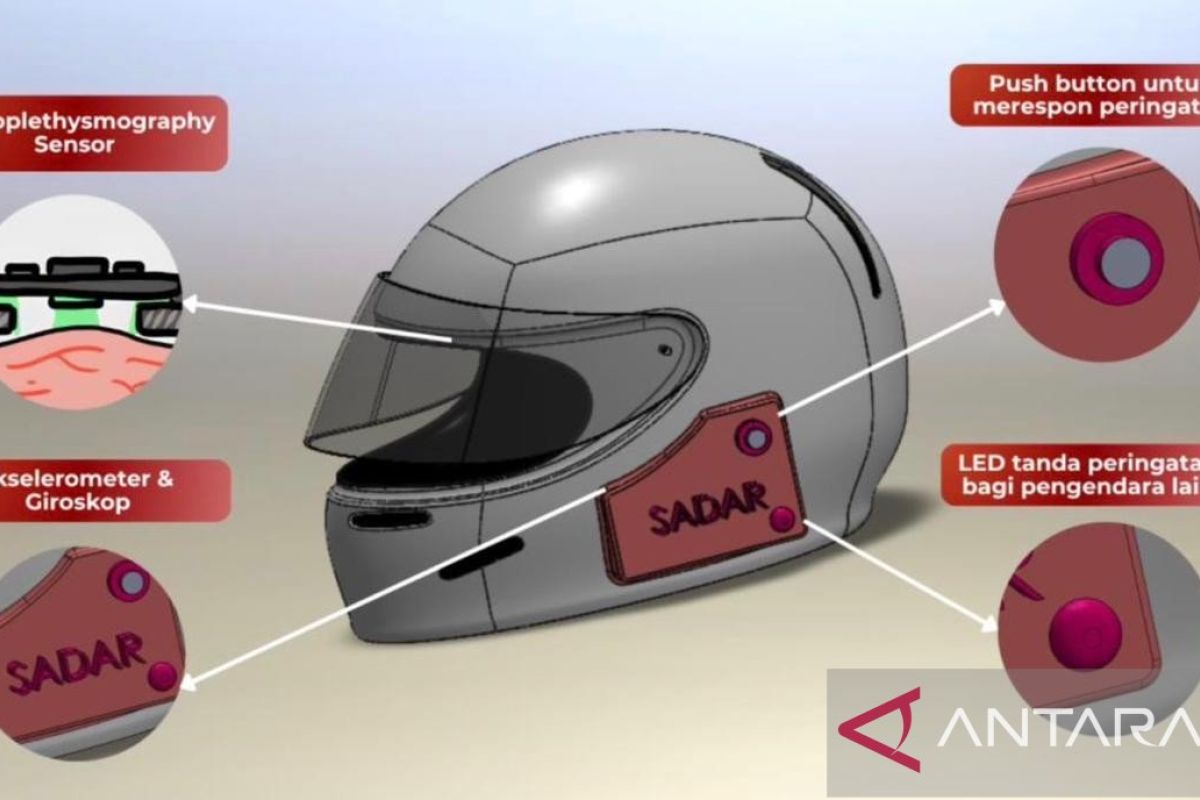
Three Industrial Engineering students from the Bandung Institute of Technology (ITB), forming the iConic team, have developed the ‘SADAR Helmet’, an Internet of Things (IoT)-based smart helmet capable of detecting microsleep symptoms in motorcyclists. The innovation secured second place nationally in the 2026 Smart Safety Competition (SASECOM) organised by the Occupational Safety and Health Forum of the Faculty of Public Health at Diponegoro University (FKM Undip).
‘We chose this topic because microsleep is a real and highly relevant problem in Indonesia, especially for motorcyclists who dominate the national accident statistics,’ said team representative Mahesya Friemay Romadhoning in Bandung on Saturday. He noted that developments in IoT and smart mobility present significant opportunities to introduce preventive safety systems that are affordable and easy to implement.
The SADAR Helmet is designed as a retrofit device, meaning the monitoring system can be attached to standard SNI-certified helmets already on the market without altering their original structure. This approach makes the cost of implementation far more accessible compared to camera-based or EEG drowsiness detection systems.
Technically, the helmet integrates a Photoplethysmography (PPG) sensor to read heart rate and Heart Rate Variability (HRV), along with an accelerometer and gyroscope to monitor the rider’s head movements in real time. Team member Rizky Miftah Alfiah explained that the prototype design process utilised SolidWorks and AutoCAD software, with rigorous safety validation based on scientific journals, all while managing a busy academic schedule.
‘The process took a lot of time because we spent days brainstorming to come up with the SADAR Helmet concept. Coincidentally, we are also taking a Product and Business Development course, and occupational health and safety is one of the study areas in Industrial Engineering,’ he said.
Fellow team member Muhammad Yasser Saputro expressed hope that the innovation could be further developed through integration with mobile applications, GPS tracking, cloud monitoring, and artificial intelligence-based analysis to improve detection accuracy. The iConic team is now pursuing collaboration opportunities with national helmet manufacturers, the automotive sector, and the government to enable mass production of this technology aimed at reducing traffic accidents.
‘We learned that the success of an innovation comes not only from a good idea, but also from strong research, teamwork, communication, and the ability to understand real problems in society,’ the team stated.