
Israel's Iron Dome Breached: USD 40 Billion Technology Overmatched by a USD 20,000 Drone
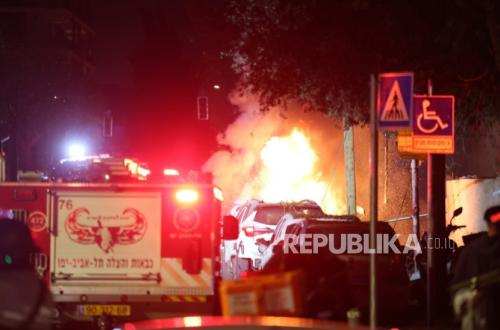
The night of 2 March 2026 will be remembered as the moment the myth of Western technological superiority collapsed. Israel’s Iron Dome — a USD 40 billion air defence system (Rp 600 trillion) — was breached by Shahed drones priced at USD 20,000 (Rp 200 million) and the hypersonic Fattah-2 missile.
The US air bases in Kuwait and Qatar were paralysed. Three F-15s were shot down by Patriot missiles of their own. And Trump, the dealmaker, now pleads for a ceasefire through Italy — not from a position of strength, but from desperation.
This is a brutal demonstration that in physics analysis, an efficient complex system defeats a complex system that is inefficient. And in Quranic terms, this is a repetition of the historical pattern: superior technology does not guarantee victory when facing a party that fights with belief and an asymmetric strategy.
Energy Efficiency Law: Cheap Drones vs Expensive Missiles
Surah Al-Anfal verse 60 commands: “Prepare whatever strength you are able to for the battle.” Iran interprets this not by buying the most expensive technology, but by developing the most efficient strategy.
Iran’s “Hypersonic Thunder” strategy is a masterclass in the thermodynamics of warfare. Thousands of Shahed drones costing Rp 200 million each surge forward first as decoys — forcing Iron Dome to fire interceptor missiles costing Rp 1.5 billion per unit. When the defensive system runs out of ammo or becomes overloaded, the hypersonic Fattah-2 missiles strike precise targets: Mossad headquarters, air bases, military command centres.
In physics terms, this is a “saturation attack” — flooding the system with input beyond its processing capacity. Iron Dome is designed to intercept 90% of threats in limited numbers. But when faced with 1000+ drones simultaneously plus dozens of Mach 10 hypersonic missiles, the system collapses. Like a computer overloaded to the point of hanging, Iron Dome becomes a sitting duck — a stationary target that is powerless.
Cost-effectiveness is terrifying in Iran’s hands: at USD 20 million (the cost of 1000 Shahed drones), they force Israel to burn USD 1-2 billion on interceptors. This is asymmetric warfare in its purest form — draining the enemy’s resources with minimal cost.
System Entropy: From Supremacy to Chaos
Intelligence reports from Strategic Intelligence indicate that the Nevatim and Tel Nof air bases in Israel have their runways destroyed. The F-35 — the most advanced aircraft at USD 1.5 trillion per unit — is now a sitting duck because it cannot take off. The US bases at Ali Al Salem (Kuwait) and Al Udeid (Qatar) suffer the same fate.
In thermodynamics, this is a dramatic rise in entropy — from order (operational air bases) to total chaos (destroyed infrastructure). Iran’s brilliant strategy: they do not need to dogfight the F-35 in the air (where they would surely lose). Simply destroying the runway with ballistic missiles makes the most advanced aircraft scrap in hangars.
This is a repetition of the same principle seen when the Prophet Muhammad faced the Quraysh at Badr. The Quraysh had 1000 troops with superior weaponry. The Muslims had 313. But the Muslims won because of the superior strategy: choosing a battlefield that favours them (near a water source), timely attack at dawn, and high morale (spiritual conviction).
Surah Al-Anfal verse 17 reminds: “It is not you who kill them, but Allah who kills them. And it is not you who throw, but Allah who throws.” This is not a passive teaching — it is the recognition that victory comes from a combination of human effort and a fate that cannot be calculated by the enemy.
Resonance of Friendly Fire: When the System Consumes Itself
The most humiliating incident is the “friendly fire” in Kuwait: three F-15s shot down by Patriot missiles belonging to their own side. The US air defence radar experiences an “IFF Failure” — it cannot distinguish friendly aircraft from enemy missiles.
In physics terms, this is a destructive “positive feedback loop”. When radar systems are jammed by Iranian electronic warfare (likely Chinese technology), Patriot operators panic at the many blips on the screen. They fire at everything moving — including their own F-15s. Three aircraft worth around Rp 1 trillion in total are destroyed not by the enemy, but by their own system collapsing in chaos.
This repeats the principle taught in Surah Al-Hashr verse 14: “They will not fight you as one, except in fortified towns or behind walls. Their hostility among themselves is very strong.” Iran does not need to destroy all US aircraft — merely to drive the system into internal conflict.
Logistics Collapse: The Thermodynamic Limit of Modern War
Business Insider reports that the US has burned through stockpiles of Tomahawk missiles to an alarming extent. The Pentagon is now faced with a dilemma: to continue war in the Middle East means facing China in the Pacific in the nude. This is the “thermodynamic limit” — a physical boundary at which a system cannot continue because energy (ammunition, resources, political will) is exhausted.
ADS-B flight data shows dozens of MEDEVAC aircraft (C-17 and C-5) flying non-stop from the Gulf to Ramstein, Germany. This is “excavation sorties” — evacuating casualties extracted from the rubble of bases that collapsed. The Pentagon officially claims only four deaths. But the intensity of medical evacuation suggests hundreds of personnel were casualties.
Trump, campaigning on “America First”, now pleads for a ceasefire via Italy — not from strength, but from desperation. In physics terms, this is a “strategic retreat” — retreat before a total system collapse. But Iran refuses: there is no ceasefire without the complete withdrawal of all US bases in the Gulf.
Surah Al-Baqarah verse 216 reminds: “Warfare is imposed upon you, though you may hate it. It may be that you hate a thing which is good for you.” The US resents the reality that the technology