
Israel Refuses to Contribute to Gaza Reconstruction Fund, Losses Estimated at Billions
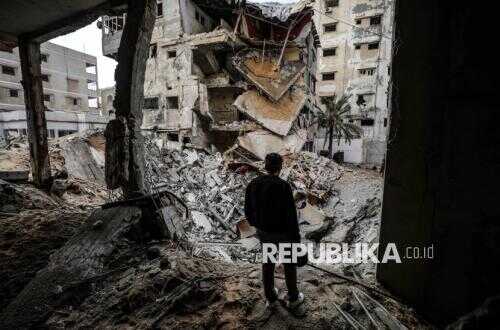
REPUBLIKA.CO.ID, TEL AVIV – Israel has refused to contribute financially to the reconstruction of the Gaza Strip through the US President Donald Trump’s Peace Council. This decision comes despite the massive losses inflicted after more than two years of devastating Gaza.
Since the Israeli attacks on the Gaza Strip in October 2023, the Palestinian coastal region has experienced massive destruction of infrastructure, property, and the economic sector. The impact is not only on social and community life but also has significant material implications that will take decades to recover from.
A joint report by the World Bank and the United Nations (UN) states that physical damage to vital infrastructure in Gaza reached approximately $18.5 billion by the end of January 2024. This includes damage to the housing sector, clean water facilities, health, education, as well as industrial and commercial buildings. This figure is equivalent to 97 percent of the combined Gross Domestic Product (GDP) of the West Bank and Gaza in 2022.
An extended study by the Gaza Government Agency estimates that initial direct losses for 15 vital sectors throughout 2025 have exceeded $33 billion, including widespread destruction in the agricultural, livestock, and fisheries sectors, as well as electricity networks and other public services.
Some statistical data published by the Government Media Office in Gaza even indicates that total material losses have reached approximately $70 billion over two years of conflict, including damage to housing, public facilities, education, health, and other productive sectors.
Throughout the two years of genocide, tens of thousands of homes in Gaza have been destroyed or severely damaged, leaving millions of people homeless. Hundreds of kilometers of electricity, water, and road networks have also reportedly been completely paralyzed.
The amount of debris is estimated to reach tens of millions of tons, making the cleaning and reconstruction process difficult. Health and education facilities have been severely damaged, with many schools and hospitals no longer operational.
Basic community services such as clean water, sanitation, and electricity have been disrupted, exacerbating the humanitarian situation. Agricultural land, wells, and production equipment have been severely damaged, destroying the livelihoods of local communities and triggering dependence on foreign aid. Losses in the agricultural sector are estimated to reach billions of dollars.
Economic activity in Gaza has also almost stopped, triggering a sharp contraction in the Gaza economy.
Referring to the UN, estimates of the cost of reconstruction and infrastructure recovery in Gaza over the next decade range from $40 billion to $53 billion, depending on the level of access, security, and international support. The widespread damage is not only a financial loss but also presents structural challenges for the long-term socio-economic recovery of the Gaza community.
Throughout the more than two years of genocide, Israel has killed at least 72,000 Gazan civilians, mostly children and women. Since the ceasefire was announced on October 10, 2025, more than 600 Gazan civilians have been killed in various ceasefire violations.