
Israel blocks Gaza Hajj pilgrims, Muslims denied access to Mecca
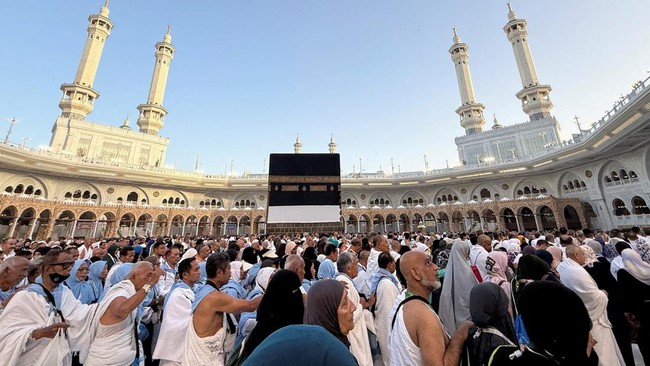
Jakarta, CNBC Indonesia - The Israeli government has once again completely blocked Muslim pilgrims in Gaza from departing for Hajj for three consecutive years. The Zionist state closed its borders as millions of Muslims worldwide gathered in the holy city of Mecca, Saudi Arabia.
According to Al Jazeera’s report on Sunday, one of the victims is 65-year-old Hanan al-Hams. She was among the 3,000 Palestinians from Gaza scheduled to travel for the annual pilgrimage to Mecca in 2024.
However, her lifelong dream of performing Hajj, one of Islam’s five pillars, was shattered by Israel’s war in Gaza, which began on 7 October 2023.
“I have lost my son, my home is destroyed, and now I am denied the journey I have waited for decades,” al-Hams said during an interview in an emergency tent erected on the ruins of her home in northern Gaza, according to a report on Monday, 25 May 2026.
The movement in and out of Gaza has long been controlled by Israeli authorities even before the war. While some border crossings at Rafah, Gaza’s only external link, were partially opened in February, they only allow passage for patients requiring urgent medical treatment abroad.
For all other travel needs, including Hajj, education, and employment, leaving the enclave has become nearly impossible due to Israel’s land, air, and sea blockade, in place since 2007. Today, the majority of Gaza’s 2.3 million residents remain displaced, living in tents or ruined homes after Israeli forces reduced the enclave to rubble.
A ceasefire agreement was reached in October 2025 to officially end the war. However, Israel continues its military offensive and still occupies over 60% of Gaza, violating the truce.
“The war has ended, and we hoped to perform Hajj, but for three years now, I haven’t been able to leave,” said Adnan Abu Foul and his wife, Um Ibrahim, sobbing as they watched pilgrims circumambulating the Kaaba on a small mobile screen.
According to data from Gaza’s Ministry of Waqf and Religious Affairs, over 10,000 residents have been prevented from performing Hajj in the past three years due to Israel’s unilateral closure of the Rafah crossing with Egypt. The ministry also noted that at least 71 Hajj applicants who won official lottery spots in previous years died in Israeli attacks before they could undertake the sacred pilgrimage.
The impact of denying Gaza’s Hajj pilgrims extends beyond border closures, revealing a ‘systematic dismantling of the religious tourism economy’ in the enclave. A May 2026 study by the Palestinian Center for Political Studies (PCPS) described Israel’s military campaign against Gaza’s Hajj and Umrah sector as ‘structural economic genocide’ targeting the region’s religious tourism-based economy.
“Since Umrah is an optional pilgrimage to Mecca that Muslims can perform at any time of the year,” said researcher Khaled Abu Amer.
The study revealed the total collapse of 78 licensed travel companies in the religious tourism sector. The Gaza Hajj and Umrah Companies Association reported that most travel agencies have been severely damaged or completely destroyed in the conflict.
This mass destruction has caused capital losses exceeding $4 million (£3.2 million), with an estimated $2-3 million in frozen funds held by external agencies such as airlines and hotels in Saudi Arabia and Egypt.
Before the war, the tourism sector injected at least $12 million annually into the local economy. This massive loss of revenue has directly impacted over 1,500 direct and indirect workers and their livelihoods.
Local Hajj operator Mohammed Abdul Bari stood before the ruins of his destroyed business, recalling how they once deployed up to 20 bus fleets for mass pilgrim departures, now all reduced to rubble. PCPS reports confirmed that the repeated targeting of this sector proves Israel’s deliberate destruction policy, not mere collateral damage.
Violating the Geneva Conventions
Legally, this systematic destruction constitutes collective punishment, strictly prohibited under Article 33 of the Fourth Geneva Convention. Additionally, blocking citizens from religious travel through Israel-controlled crossings violates both freedom of religion and freedom of movement under Articles 18 and 12 of the International Covenant on Civil and Political Rights, as well as Article 53 of the Fourth Geneva Convention prohibiting the destruction of civilian property.
As a result of the total blockade, the annual Hajj quota of around 3,000 pilgrims has been reallocated to Palestinians from Gaza holding Egyptian or other nationalities. Thousands of slots have also been temporarily reallocated to pilgrims from the West Bank and East Jerusalem.