
Islamic Economics Experts Meet Coordinating Ministry for Economic Affairs, Criticise US Trade Agreement
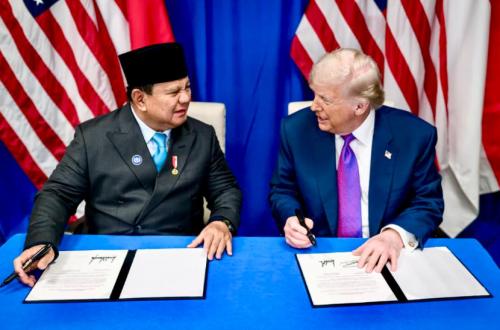
The Central Leadership Board of the Indonesian Association of Islamic Economists (IAEI) collaborated with Indonesia’s Coordinator for Economic Affairs to organise a Focus Group Discussion (FGD) examining the strategic implications of the Agreement on Reciprocal Trade (ART) between Indonesia and the United States.
Held on Friday, 13 March 2026 at the Ali Wardhana Building of the Coordinating Ministry for Economic Affairs, the forum gathered cross-sector stakeholder input on the impact of ART on national trade, data sovereignty, investment climate, and harmonisation of halal certification standards and local content components.
The Secretary of the Coordinating Ministry for Economic Affairs, Susiwijono Moegiarso, explained that the ART, formally signed on 19 February 2026, represented a successful economic diplomacy outcome in averting the threat of US reciprocal tariffs reaching 32 percent. Through intensive negotiations, national export tariffs were reduced to between 19 and 15 percent, with zero tariffs on strategic commodities supporting exports such as palm oil, soya beans, coffee, cocoa, rubber, spices, and electronic components. The agreement also opened access to 1,819 preferential tariff lines.
In response to public discourse, Susiwijono stressed that the policy does not eliminate domestic halal obligations. The ART purely regulates the mechanism of recognising foreign halal certification bodies to facilitate efficient international trade, whilst maintaining the principle of Muslim consumer protection within Indonesia’s regulatory framework.
In response to this presentation, IAEI experts provided substantive critical observations regarding economic resilience and geopolitical dynamics. Professors Didin Damanhuri and Euis Amalia emphasised the importance of carefully managing market potential to prevent import penetration from undermining the self-reliance of domestic SMEs. They also cautioned against tariff risks that are frequently weaponised by the US geopolitically, to ensure Indonesia does not fall into deeper trade deficits.
Concurrently, Professor Telisa Aulia Falianty stressed the urgency of securing cross-border financial transaction data—such as QRIS, Visa, and Mastercard infrastructure—and the necessity of addressing Indonesia’s services trade deficit with the US, whilst exploring potential US interest in Islamic financial instruments such as Green Sukuk/Sharia-compliant bonds.
Regarding halal governance harmonisation, academics highlighted regulatory asymmetry between the two countries. Professor Murniati Mukhlisin explained fundamental differences in bureaucratic structure, with Indonesia grounded in state regulation (Law No. 33 of 2014) whilst the US halal ecosystem is managed by private institutions (such as IFANCA and ISA). Harmonisation of standards by the Indonesian Halal Product Assurance Agency (BPJPH) is therefore deemed crucial. This aligns with Professor Achmad Kholiq’s view emphasising the importance of policy analysis based on the maqashid shariah framework for community wellbeing. Complementing this, M Hasan Gaido cautioned the need for comprehensive market intelligence approach so that the public views this issue not merely through the lens of goods trade, but also through a broader protection dimension.
Another critical aspect was the urgency of improving government policy governance and public communication. Professors Andi Faisal Bhakti, Nur Rianto Al Arif, and Dian Masyita evaluated government information delivery as excessively technocratic. This risks triggering public misperceptions and anxiety regarding fiscal deficit pressures and religious law issues. To dampen such negative sentiment, IAEI recommended involvement of the People’s Consultative Assembly in discussions of this international agreement, and urged the Presidential Spokesman to issue an official quotation brief so that policy substance can be conveyed transparently, proportionally, and in an easily understood manner to the public.
“The government remains committed to strengthening dialogue spaces so that ART is understood comprehensively as a strategic instrument for strengthening bilateral cooperation, critical mineral investment, energy, technology, and global halal supply chains,” Susiwijono concluded in response to the constructive input.
As concrete follow-up, all evaluations and recommendations from this FGD will be further consolidated within the IAEI’s Muzakarah forum, which will subsequently produce a strategic policy navigation blueprint for government and the business sector amid global economic challenges.