
Islamic Blended Financing: Strengthening National Sharia Economy Growth
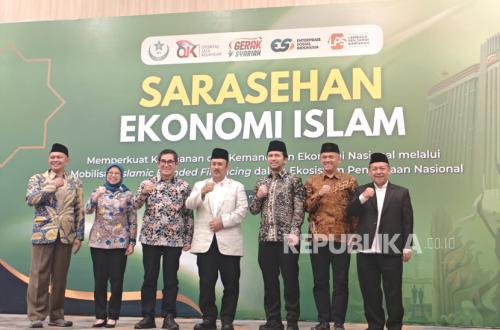
Islamic Blended Financing, or mixed Sharia financing, continues to be promoted to strengthen the growth of Islamic economics and finance. Rachmat Pambudy, Minister of National Development Planning and Head of Bappenas, stated that the development of Islamic Blended Financing is a strategic step to link Islamic economic values with the national development agenda.
“Islamic blended finance is not merely an economic concept, but can serve as an instrument for building a more just and prosperous society,” he said at an Islamic Economics Dialogue in Surabaya, quoted in a press release received by Republika on Monday (9 March 2026).
According to him, Islamic values need to be translated concretely in addressing various national development challenges. Therefore, strengthening domestic financing is an important step in ensuring sustainable and equitable development.
At the same event, Mukhtasor, Chairman of the East Java Regional Council of Sarekat Islam, presented at least four policy recommendations regarding Islamic blended financing that could be considered by the government. These four recommendations were outlined in a Policy Brief from the Islamic Economics Dialogue as a commitment to strengthening national economic resilience and self-reliance.
The four recommendations include developing a Public-Private Funding Cooperation scheme (KPPDM), ensuring and developing waqf assets, strengthening Islamic banks’ role as waqf trustees (nazhir), and optimising the use of Cash Waqf Linked Sukuk (CWLS).
Professor Mukhtasor emphasised the importance of building national economic self-reliance by reviving the spirit of struggle of H.O.S. Cokroaminoto.
“The four policy recommendations formulated represent concrete steps to strengthen domestic financing involving community participation,” he said.
Hamdan Zoelva, President of Sarekat Islam’s Executive Board, also stated that the spirit of the Islamic Trade Association since 1905 remains relevant today, particularly in promoting equitable distribution of economic growth benefits. According to him, Islamic social funds need to continue being optimised so that they not only serve consumptive functions, but also support long-term productive programmes with lasting impact.