
Isbat Session Results: Crescent Moon Not Sighted, Ramadan to Begin Thursday 19 February
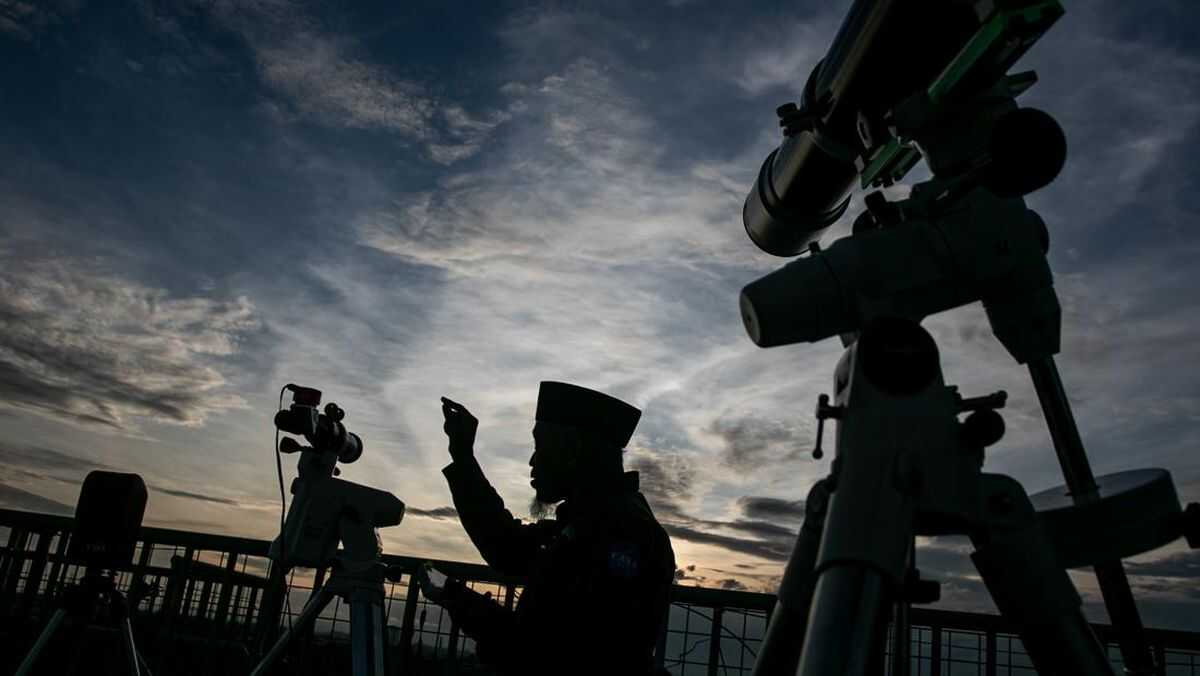
The isbat session held by the Ministry of Religious Affairs (Kemenag) has determined that the start of fasting, or 1 Ramadan 1447 Hijriah, falls on Thursday 19 February 2026.
The decision was taken based on the results of the isbat session for determining the start of Ramadan 1447 H, led directly by Minister of Religious Affairs Nasaruddin Umar at Hotel Borobudur, Jakarta.
The position of the crescent moon (hilal) was observed as negative in Indonesia, meaning its position remained below the horizon.
“Based on the results of astronomical calculation (hisab) and the absence of a visible crescent moon, it has been agreed that 1 Ramadan falls on 19 February 2026,” said Nasaruddin on Tuesday (17 February).
Member of the Ministry of Religious Affairs’ Hisab and Rukyat Body, Cecep Nurwendaya, outlined the positions of the moon and sun in Central Jakarta on 17 February, noting that the moon’s daily motion lagged behind the sun by approximately 12 degrees per day or 0.5 degrees per hour.
“The sun set on 17 February 2026 at 18:15:17 Western Indonesian Time (WIB), with the crescent moon’s age at 50 seconds (the hilal had not yet been ‘born’) 45 minutes,” Cecep explained during a seminar on determining the start of Ramadan 1447 H on Tuesday.
On the same day, the sun rose at 05:58 WIB.
Meanwhile, the ijtimak — the position when the Earth, Moon and Sun are aligned on the same astronomical longitude — occurred on 17 February at 19:01, with the hilal’s age at zero hours.
In greater detail, at ijtimak on 16 February the moon’s altitude was -11.93 degrees, then on 17 February at 19:01 it was -1.05 degrees, followed by 18 February at 8.76 degrees.
Cecep also explained the altitude of the crescent moon across Indonesia from that day onwards.
“The hilal altitude ranged from -2° 24’ 43” (-2.41 degrees) to -0° 55’ 41” (-0.93 degrees),” said Cecep.
The determination of the crescent moon for the start of a Hijri month, including Ramadan, can be conducted through two methods: hisab, or mathematical calculation, and rukyat, or direct observation. Additionally, the reference altitude of the crescent moon can also influence when Ramadan commences.
Hisab uses numerical-mathematical calculations to establish the start of a Hijri month without factual verification or crescent moon observation.
Through hisab, Muslims can calculate the geometric positions of celestial bodies to determine scheduling on Earth, including for the lunar months associated with worship.
Meanwhile, rukyat is a monitoring method that involves direct observation of the crescent moon.
Consequently, Indonesia is currently experiencing a one-day difference for 1 Ramadan, as Muhammadiyah has decided that obligatory fasting in the holy month begins on Wednesday (18 February).
Similarly to the government, Nahdlatul Ulama (NU) conducted its own separate observation and isbat session, arriving at a decision not far removed from the government’s.
The government has urged respect for the differing methods used by each party regarding this year’s discrepancy over 1 Ramadan.
Muhammadiyah
Meanwhile, Muhammadiyah has determined that 1 Ramadan falls on Wednesday (18 February).
Muhammadiyah officially set 1 Ramadan 1447 H on 18 February, as stated in the Central Leadership of Muhammadiyah Circular Number 2/MLM/I.0/E/2025 and the Tarjih and Tajdid Council Explanation Number 01/MLM/I.1/B/2025.
This determination uses the Unified Global Hijri Calendar (Kalender Hijriah Global Tunggal/KHGT) as a new method that has now become Muhammadiyah’s official reference, replacing the previously used wujudul hilal method.
The implementation of the KHGT requires the integration of three main elements known as the Principle, Condition and Parameter (PSP) framework.
One of its key parameters is that the hilal position after ijtimak must meet a minimum altitude of 5 degrees and an elongation of 8 degrees anywhere on the Earth’s surface, not limited to any specific territory.