
Is US-Israel Aggression Truly Causing Cracks in Iran?
Vedi R. Hadiz’s article on the Iran war and its overlooked consequences (Kompas, 23 March 2026) offers an important perspective: that the impact of conflict is not solely determined by military strength, but also by domestic social-political dynamics. In this context, Iran is portrayed as a country with structural vulnerabilities that could be exacerbated by war.
Broadly speaking, there are several key arguments in that piece.
First, war is said to deepen social and economic tensions in Iran. High unemployment, inflation, and social inequality—particularly among the younger generation—are seen as factors that could trigger further instability.
Second, the article highlights long-standing social and political fragmentation. Waves of protests from 2009 to the “Woman, Life, Freedom” movement indicate recurring and unresolved dissatisfaction.
Third, there is emphasis on shifts in the position of important social groups, such as the educated middle class and bazaar networks, which have historically supported the system. The weakening of this social base is assessed as potentially reducing the regime’s political resilience.
Fourth, Hadiz views war as potentially opening space for political change, though not deterministically. In other words, external conflict could amplify internal pressures on the state.
These arguments are important because they remind us that political stability is not determined solely by military might, but also by social legitimacy and economic capacity. Nevertheless, there are several critical notes that need to be raised to make the analysis more balanced.
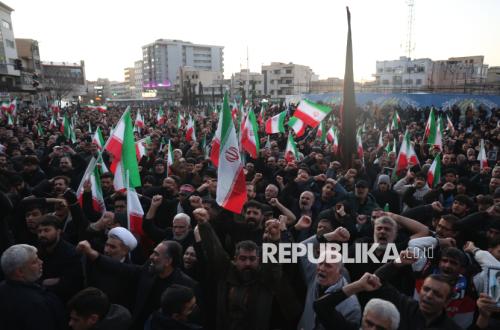
First, the piece tends to underestimate the rally-around-the-flag effect. In wartime situations, societies often consolidate support for the state in response to external threats. Iran’s experience during the Iran-Iraq War shows that conflict can strengthen, rather than weaken, the regime’s legitimacy in the short term.
Second, the assumption that social dissatisfaction will automatically transform into effective political pressure seems overly optimistic. Iran has significant state capacity, including strong security forces like the Islamic Revolutionary Guard Corps. Experiences from various waves of protests show that social mobilisation does not always lead to systemic change.
Third, the external geopolitical dimension has not received adequate attention. Iran is not a standalone actor. Relations with major powers like China and Russia, as well as regional networks of influence, can serve as important supports for the state’s resilience in crisis situations.
Fourth, the economic pressures discussed in the article have not been fully linked to Iran’s adaptive capacity against long-standing sanctions. Over the past two decades, Iran has developed various mechanisms to survive under external pressure, so the economic impact of war is not always linear in relation to political stability.
Ultimately, war can indeed be a severe test for any nation. However, it is important to distinguish between potential pressures and the likelihood of change. Not all pressures lead to collapse. In many cases, the opposite is true: states that endure external pressures can emerge in a more consolidated position.
In this context, Iran may face erosion of legitimacy in the long term. But in the short term, war could potentially strengthen internal cohesion and state capacity. Analysis of such conflicts therefore needs to maintain a balance between reading vulnerabilities and understanding resilience.