
Is the Maximum Retail Price of Minyakita Backfiring? Here's What a Cooking Oil Entrepreneur Says
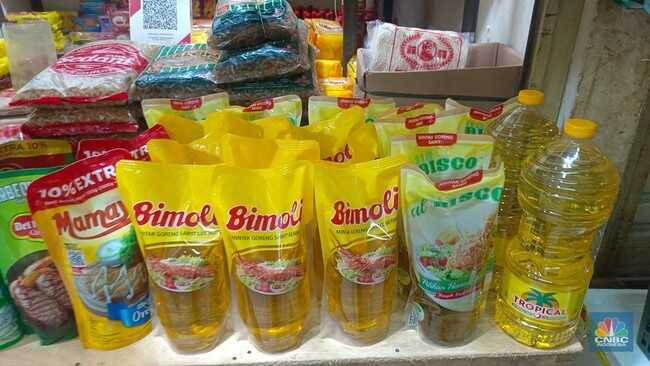
Jakarta, CNBC Indonesia - The government’s plan to encourage producers to offer affordable cooking oil through a second brand is seen as only effective if Minyakita cooking oil is no longer sold freely and is focused as a subsidized oil or food aid for low-income communities.
The Executive Director of the Indonesian Vegetable Oil Industry Association (GIMNI) and Chairman of the Indonesian Palm Oil Council (DMSI), Sahat Sinaga, said that the current maximum retail price (HET) policy for Minyakita is not well-targeted because it is enjoyed by all levels of society, including high-income groups.
“We need to help those who are in need. According to BPS (Statistics Indonesia) data, around 9.2% of the total 280 million population are poor. The rest should pay the normal price,” said Sahat when met in Jakarta, Wednesday (February 25, 2026).
He believes that the implementation of the Minyakita HET is actually creating a large burden for the country. Sahat explained that with the Minyakita HET of IDR 15,700 per liter, the Value Added Tax (VAT) collected is only around IDR 1,600 per liter. In fact, according to his calculations, the fair price for cooking oil should be around IDR 19,800 per liter, with a potential VAT of around IDR 2,000 per liter.
“This means there is a difference of around IDR 400 per liter,” he said.
With a Minyakita distribution volume of around 3.2 billion liters per year, Sahat estimates that the potential loss of state revenue from VAT alone could reach almost IDR 1.4 trillion per year. If added to the overall burden of the HET policy, the state’s losses could reach around IDR 1.8 trillion per year.
“This is what needs to be realized. We are making it easier for the rich,” he said.
Second Brand Option Will Be Difficult to Be Effective
Regarding the concept of a second brand as a complement to Minyakita, Sahat said that it will only be effective if the cooking oil is truly made a subsidized product, which is distributed specifically to poor communities, while other people buy cooking oil at market prices and pay taxes normally.
“The second brand will be successful if Minyakita is specifically intended for those in need,” he said.
He also emphasized that if subsidized Minyakita is sold cheaply outside the target group, then this practice should be treated as a criminal offense.
“If there is a sale of Minyakita at a low price to those who are not entitled, that should be a crime,” said Sahat.
Sahat said that as long as the price of the second brand is above the Minyakita HET, the policy will not be attractive to consumers.
“Price is the issue. Minyakita has an HET, while the second brand is a normal price according to market mechanisms. I think it won’t work,” said Sahat.
He believes that Indonesian consumers tend to always look for the cheapest price, regardless of income level. According to him, this condition makes it difficult for higher-priced cooking oil products, including premium and second brands, to compete with Minyakita.
“Premium brands are available in supermarkets. But because the price is high, people switch to lower prices,” he said.
Sahat also highlighted the current narrowing of the cost structure for cooking oil production. With the price of CPO (crude palm oil) at around IDR 14,300 per kilogram, plus distribution costs to the Java region of around IDR 4,450 per kg and VAT, the basic price at the factory is already approaching IDR 16,000 per kg or around IDR 15,000 per liter.
“This is just at the factory. Not yet at retail. How much will it be sold for?” he said.
According to Sahat, this condition makes it almost impossible for producers to sell cooking oil below the HET without incurring losses. However, producers still implement the policy to maintain business continuity.
Higher CPO Prices, Government Maintains Minyakita HET
Previously, the Minister of Trade, Budi Santoso, revealed that the current price of CPO is much higher than three years ago when the Minyakita HET policy was established. Although it had corrected by about 15%-16% last year, the average price of CPO has risen again and is now at IDR 14,035 per kg.
“Now the price of CPO for cooking oil ingredients was in Palembang at IDR 14,035, the CPO,” said Budi when met at the Ministry of Trade Office, Jakarta, Wednesday (February 18, 2026).
This price is above the HET for distribution from producers to the first-level distributors (D1) which is set at IDR 13,500 per liter. Budi admitted that this condition puts pressure on cooking oil producers and has the potential to cause losses.
However, he emphasized that the high CPO price will not affect the price of Minyakita at the producer level. The government, he said, continues to coordinate and supervise so that producers still sell Minyakita according to the HET.
“We continue to coordinate with them. Sales must still be in accordance with the HET. From producers to D1, IDR 13,500 per liter, D1 to D2, IDR 14,000 per liter,” he explained.
However, Budi said that the government does not yet plan to relax or adjust the Minyakita HET. As an alternative, the government is encouraging the expansion of the availability of second-brand cooking oil so that consumers have other choices in the market.
Meanwhile, the Ministry of Trade recorded an increase in the Reference Price (HR) of CPO ahead of the Chinese New Year and Ramadan 2026. The Director General of Foreign Trade of the Ministry of Trade, Tommy Andana, said that the CPO HR for the period of February 1-28, 2026 was set at US$918.47 per metric ton, up 0.31% compared to January 2026.
“This increase is due to increased demand in anticipation of Chinese New Year and Ramadan, which is not accompanied by an increase in supply due to a decrease in production,” said Tommy.
For February 2026, the government set the CPO Export Duty at US$74 per metric ton, while the Export Levy was set at 10% of the CPO HR or equivalent to US$91.85 per metric ton.