
Is Money Exchange Service Subject to Tax? Here's the Explanation
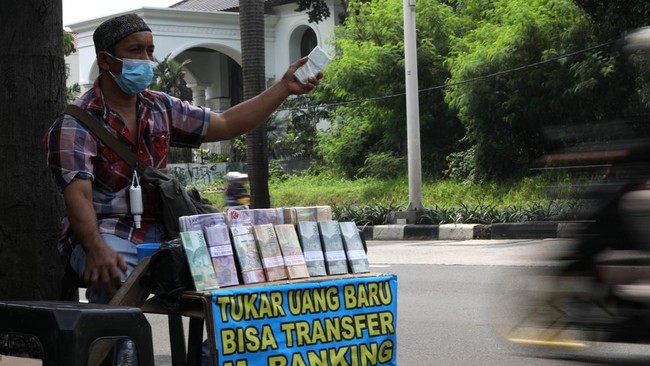
Ahead of Eid, money exchange service stalls are beginning to appear along roadside locations throughout Indonesia. These vendors typically offer exchanges of various rupiah denominations, ranging from Rp5,000 to Rp20,000 notes.
These vendors take home fewer notes but in larger quantities than when they arrive, as they typically charge a service fee for the money exchange. The denomination of the currency being exchanged affects the amount of new money received. However, is this money exchange transaction subject to taxation?
According to the Value-Added Tax (VAT) Law, currency is classified as goods exempt from VAT. This means the money exchange transaction itself is not a taxable object.
Muhammad Rifqi Saifudin, an official at the Directorate General of Taxes, explained that income is defined under Law Number 7 of 1983 on Income Tax (Income Tax Law) as an increase in economic capacity received or obtained by a taxpayer. Those exchanging money do not receive an increase in economic capacity; they merely facilitate citizens in distributing holiday bonuses in smaller denominations.
“The absence of additional economic capacity is reinforced by the reduced amount of money received by the money exchanger, as there is a deduction related to the service fee or based on the vendor’s assessment of the quality of the currency being exchanged,” Rifqi wrote in his article on the DJP website titled “Money Exchange Service Stalls: These Are the Tax Aspects”.
On the other hand, the compensation received by the vendor constitutes income and therefore there is potential personal income tax that must be paid and reported in the vendor’s Annual Tax Return.
Vendors with annual gross revenue below Rp4.8 billion can utilise the final PPh rate of 0.5 per cent based on Finance Ministry Regulation Number 164 of 2023 on the Procedures for Imposing Income Tax on Income from Business Received or Obtained by Taxpayers with Certain Gross Revenue and Business Reporting Obligations to be Designated as Taxable Entrepreneurs.
For the 2025 Tax Year, Annual Tax Return reporting uses Coretax for all taxpayers including money exchange service vendors. Coretax provides easier reporting methods for taxpayers using the final 0.5 per cent PPh rate compared to the previous e-Form method.
Previously, taxpayers using e-Form had to have Adobe PDF Reader 32-bit, and tax payments still used non-integrated e-Billing in the e-Form. Now, billing is created through Coretax so when preparing the annual tax return, taxes already paid automatically enter the system, reducing input errors for total taxes paid.
Another convenience is found in filling out the monthly revenue attachment in appendix L3B. With the e-Form method, taxpayers had to input their tax identification number (NPWP) and address for all 12 months. This is no longer necessary in Coretax as taxpayers only need to enter the revenue value for each month.
Money exchange transactions are not subject to tax, but if the vendor gains profit from the difference in the amount of money exchanged, this constitutes income that must be reported in the vendor’s Annual Tax Return.
“Meanwhile, regarding paying PPh, it depends on how much revenue is generated. If above Rp500 million, the vendor is obliged to remit PPh,” he wrote.
Security aspects during money exchange must be considered. Bank Indonesia Regulation Number 21/10/PBI/2019 on Management of Rupiah Currency states that rupiah currency exchange services are provided by Bank Indonesia or other parties designated by Bank Indonesia.
“Attention should be paid to such designated parties to reduce the risk of exchanging counterfeit money. Do not let Eid celebrations bring sorrow because the exchanged money cannot be used for transactions,” he wrote.