
Is China Approaching Europe for a Multipolar World Order Without the US?
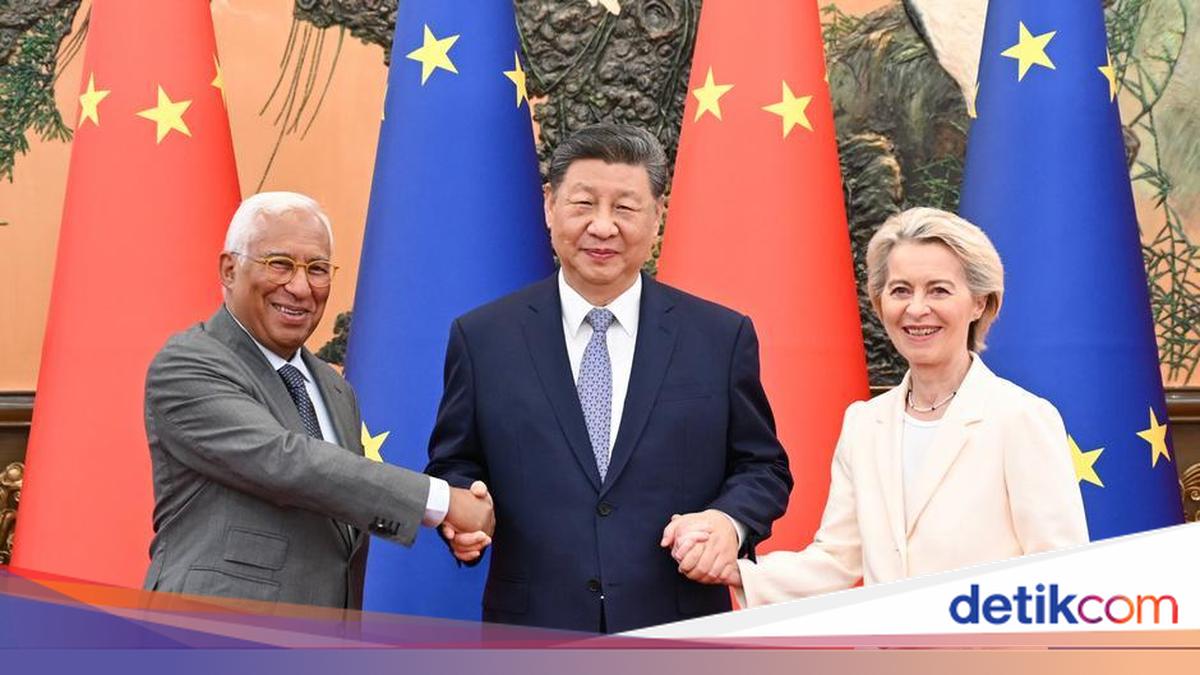
The question reflects a growing perception in China’s public discourse about Europe’s current condition: stagnant economic growth, foreign policy deemed dependent on the United States, and defence capabilities considered limited.
Eighty-one years after the end of World War II, according to this view, European countries still have to “bow” before Washington. Even the war at their own doorstep—the Russian invasion of Ukraine—could not be stopped by European powers, despite various efforts.
The studio guests did not seem surprised by the student’s observation. “This is a very serious question,” said Zhang Weiwei, dean at the China Institute. According to him, almost all dynamics in Europe are still related to the United States.
He assessed that many Europeans still regard Donald Trump’s presidency as merely a temporary phase. “They are not yet fully willing to accept the changing reality that is underway,” he said during the programme in 2025. However, Zhang added, more and more parties are beginning to see that reality.
Blind to reality in a multipolar world
A similar view was expressed by Vuk Jeremić, former president of the United Nations General Assembly who is now a professor of international relations at Sciences Po University in France.
He said that many French intellectuals struggle to accept that global changes are happening so quickly. “There is a misunderstanding that the world is indeed changing this fast,” he stated.
Beijing envisions the future of the world in a multipolar order—a concept that is China’s response to the increasingly sharp rivalry with the United States. For decades after the two world wars, Washington was seen as dominating almost all areas of global power.
Now, according to Beijing’s view, China will also help dictate that order—alongside Russia and other like-minded countries. Interestingly, in that picture, China also sees Europe as one of the independent poles of power.
The logic is simple. Europe has two veto seats on the UN Security Council through France and the United Kingdom. The European single market is also very attractive to China’s export-oriented economy—especially after the tariff war with the US.
Officials in Beijing assess that European and Chinese companies can complement each other: Europe still has technological advantages, while China offers large production capacity at competitive prices.
From Beijing’s perspective, this situation opens opportunities to make Europe a strategic partner—provided Europe can implement foreign policy and economic policies that are more independent from Washington.
Stagnant globalisation
According to Ding Chun, a professor at Fudan University and chairman of the Shanghai Institute for European Studies, globalisation has actually entered a stagnation phase since the end of the Cold War in the 1990s.
US dominance in institutions like the International Monetary Fund and the World Bank, he said, has so far supported various economic programmes in Latin America and Europe. This pattern is known as the “Washington Consensus”.
“But the times have changed,” Ding said at a forum in Shanghai in mid-April. Many things are no longer running as before, including in Europe. According to him, the younger generation is increasingly fed up with traditional political elites, while social media makes election results increasingly unpredictable.
In that context, China is trying to challenge the “Washington Consensus” by positioning the UN as the main stage for its vision of global order.
During her visit to Beijing on 29 April, the current UN General Assembly President, Annalena Baerbock, was said to have stated that China—as a founding member of the UN and a permanent member of the Security Council—has an important role in maintaining multilateralism and upholding international law.
That statement contrasts with Baerbock’s stance in 2023 when, as German Foreign Minister, she once called President Xi Jinping a “dictator”.
Chinese Foreign Minister Wang Yi used the visit to reiterate the need for UN institutional reforms and strengthening the organisation as the foundation of a multipolar world order. “China is ready to help,” he said.
A series of crises in Europe
According to Jeremić, the close relationship between the United States and Europe was initially formed after World War II due to the common threat from Soviet communism.
After the fall of the Berlin Wall, Europe enjoyed a long decade of prosperity. The continent even became a global model of how countries can overcome historical conflicts and build a shared future.
However, in recent years, a series of crises have begun to emerge.
It started with the global financial crisis, followed by the European migration crisis in 2015, then the United Kingdom’s exit from the European Union via Brexit in 2020. The situation became more complex with Donald Trump’s first term in the White House from 2017–2021 and the deteriorating European relations with Russia.
“The current situation is clearly far from ideal,” said Jeremić.
Difficult to break away from America
According to Zhang Weiwei, the European Union still tends to follow the US policy line and is increasingly internalising NATO’s logic.
He referred to the old saying about NATO’s strategy: keep Russia out, hold Germany down, and America in.
However, for Zhang, that pattern does not always align with Europe’s own interests.
Nevertheless, he acknowledged that “decoupling”—reducing dependence on the United States—would be very difficult.
One reason is Europe’s failure to lead the digital revolution known as Industry 4.0. Of the 20 largest internet technology companies in the world, not one is from Europe. American digital platforms dominate the European market and control the region’s big data.
Ironically, a few years ago, China actually hoped to learn from Germany regarding the Industry 4.0 concept—which was first introduced there.