
Iranian Warship Torpedoed by US as Senate Fails to Halt War
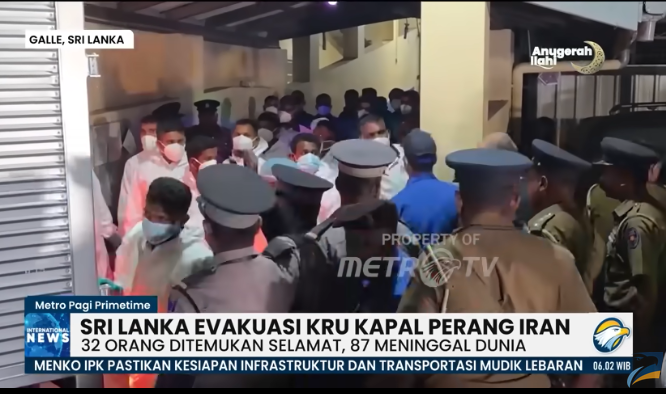
Escalation of the US‑Iran conflict reaches a critical point after the Iranian warship was sunk in the Indian Ocean. The broader confrontation has now extended to the waters off South Asia, as US authorities confirm that a US submarine has torpedoed an Iranian frigate off the coast of Sri Lanka.
‘The US submarine sank the warship that thought itself safe in international waters. This is the first time an enemy vessel has been sunk by torpedo since World War II,’ said Defense Secretary Pete Hegseth at a press conference in Washington on Thursday (5 March 2026).
Sri Lankan Navy authorities report that 32 injured sailors have been evacuated to hospital in Galle, but hope is fading for the remaining 148 crew members who remain missing. To date, 87 bodies have been recovered floating near the incident site, about 44 nautical miles from Sri Lanka’s coast.
In Washington, bipartisan efforts to curb the war powers of President Donald Trump have hit a dead end. The Senate rejected a resolution requiring Congressional approval for military action against Iran by a 53‑47 vote.
The failure of the resolution grants greater leeway for the US military to continue Operation Epic Fury. Democratic Senator Tim Kaine criticised the result, stating that the current administration has failed to present evidence of an imminent threat justifying large‑scale military aggression.
In response to the widening conflict, the West Java Provincial Government moved quickly to monitor 3,960 of its residents spread across several Middle Eastern countries. Head of the West Java Department of Information and Communications, Adi Komar, confirmed that the first data collection phase is underway.
‘We are continuing to monitor the conditions of 3,960 West Java residents, including migrant workers and students. We urge residents there to stay calm and follow official guidance from the local Embassy (KBRI),’ Adi said in Bandung.
Pemprov Jabar is coordinating intensively with the Ministry of Foreign Affairs to prepare protection scenarios should security deteriorate. Citizens are asked to keep monitoring official information and not be swayed by unverified rumours amid this global crisis.
For residents of West Java or families with relatives in the Middle East (Iran, Turkey, Saudi Arabia, Oman, Kuwait, Bahrain), the West Java Provincial Government provides a complaints and monitoring service: free pilgrimage registrations opened from 11 February 2026 to 12 March 2026.
Other support is also provided by the West Java Provincial Government for affected residents. The Governor has allocated Rp10 million to 34 households.
The operation here is described as aiming to mitigate hydrometeorological disasters, such as floods and landslides. The West Java Government has obtained permission from the Ministry of Energy and Mineral Resources to start a project for the Legok Nangka Final Waste Processing Facility (TPPAS Legok Nangka). Governor Dedi Mulyadi has set the 2026 minimum wage (UMSK 2026), though the policy applies only to 12 regions including certain cities and regencies.