
Iran War Leaves "Permanent Scars", Energy Prices Struggle to Fall
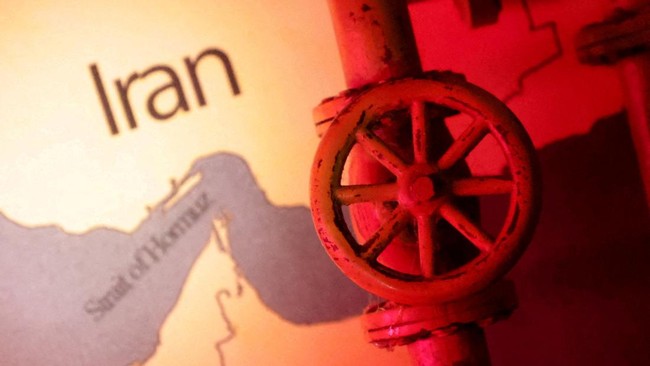
Jakarta, CNBC Indonesia - The global energy market breathed a sigh of relief after US President Donald Trump announced a two-week ceasefire in the Gulf region, conditional on the full, immediate, and safe reopening of the Strait of Hormuz.
The announcement immediately pressured world oil prices, with Brent falling 12% from US$103 to US$91 per barrel. Brent has not been as volatile as this since the early days of the Covid-19 pandemic.
However, behind this price decline, the energy market remains far from stable. Geopolitical uncertainty, distribution disruptions, and infrastructure damage mean the market is expected to face pressure for some time to come.
Market Still Vulnerable, Risks Not Gone
Before the ceasefire announcement, the energy market showed significant pressure. US-West Texas Intermediate (WTI) oil prices even traded higher than Brent at one point, a strong indication that buyers were racing to secure supplies.
Additionally, Dated Brent prices touched a record US$144 per barrel just hours before the ceasefire was announced.
Although prices are now starting to fall, oil remains about 30% more expensive than before the conflict, while gas prices have risen around 40%.
Hundreds of Ships Still Trapped in Strait of Hormuz
The turmoil in the global energy market caused by the US-Iran conflict stems from several factors, one of the main ones being the closure of the Strait of Hormuz.
Currently, around 187 tankers carrying 172 million barrels of oil and refined products are still trapped in the Gulf region.
Not only that, around 15 liquefied natural gas (LNG) carriers and dozens of fertiliser transport ships are also held up. If other cargo ships are included, the total number of trapped vessels reaches 715.
Although theoretically this congestion could be cleared in a week, many ship operators remain reluctant to pass through until security is fully guaranteed.
Previous experience shows that when the Houthis (Yemen’s Iran-backed militia) halted attacks on ships in the Red Sea in October 2025, Maersk—a major commercial shipping company—still needed about two months before daring to cross the route again.
Moreover, amid heightened fears, ship insurance premiums have surged. As a result, recovery of shipping traffic is expected to take weeks and will incur much higher costs than before the war.
Risks and Costs Still Looming
The flow of ships re-entering the Gulf to load cargo remains very limited due to the high risks if peace negotiations fail.
This situation leads many high-value ship owners, especially LNG carriers, to hold back. Even analysts from Columbia University assess that almost no operators are willing to bring ships into the Gulf at present, so additional LNG supply is likely to come only from cargoes already inside the region that can exit soon.
Uncertainty also arises from potential additional costs. During the conflict, ships seeking passage had to pay Iran up to US$2 million per transit. If this policy continues, round-trip travel costs could reach US$4 million.
Such costs could undermine the competitiveness of oil from the Gulf region, especially for smaller ships.
Johannes Rauball, an analyst at Kpler, points out that the US$4 million cost could drive smaller tankers, like Aframax vessels (carrying 600,000-800,000 barrels), out of the market as they can no longer operate viably.
Furthermore, even if ship congestion is resolved, its impact on global energy supply will not be felt immediately. Ships heading to Asia take at least three weeks to arrive, while deliveries to Europe can take four to six weeks.
At the same time, many ships have switched to loading from other regions, so the normalisation of supply is expected to take months.
Energy Production Recovery Will Take a Long Time
On the production side, the impact is even more serious. The conflict has slashed more than 10 million barrels per day of oil production—about 10% of global demand. Production recovery cannot be done instantly due to the risk of damaging oil wells.
Meanwhile, the gas sector faces heavier challenges. Attacks on LNG facilities in Qatar have damaged about 17% of production capacity, with repair estimates of 3 to 5 years. Even to return to full capacity, the still-operational facilities are expected to take nearly four months.
The effects extend to various sectors, including fertilisers and the metals industry. Damage to aluminium facilities in Abu Dhabi is even estimated to take up to a year for full recovery.