
Iran War Heats Up, China-Pakistan Step In to Save Hormuz
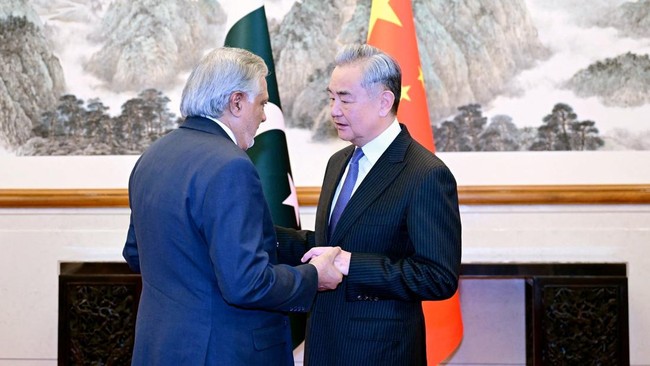
Pakistan and China have officially released a five-point peace proposal for the Middle East on Tuesday (31/03/2026). This comes after Pakistan’s Foreign Minister Ishaq Dar flew to Beijing in an effort to negotiate an end to the war between the United States (US) and Israel against Iran.
The one-day meeting between Ishaq Dar and his Chinese counterpart, Wang Yi, occurred as Pakistan continues to push for a role as a peacemaker between the US and Iran, even as the war shows few signs of abating. China’s Foreign Ministry issued an official statement on the strategic objectives of the high-level meeting.
“This visit is intended to strengthen cooperation between China and Pakistan regarding the ongoing conflict in Iran and to undertake new efforts in advocating for peace,” read the official statement from China’s Foreign Ministry.
So far, China has maintained a very careful distance from the ongoing conflict in the Middle East and the Gulf, despite its relations with the regime in Tehran and being Iran’s largest oil buyer.
Although Beijing condemned the initial US and Israeli attacks on Iran, it has since adopted a largely neutral stance, focusing its efforts on calling for a ceasefire while negotiating directly with Tehran for safe passage for its own oil tankers through the Strait of Hormuz.
In a joint statement following Tuesday’s meeting, Pakistan and China collectively called for an immediate ceasefire and protection for the security of waterways, including the blockaded strait, and released a five-part peace initiative. The joint statement agreed that dialogue and diplomacy are the only viable option for resolving the conflict, but there appears to be little substantive progress in bringing key participants to the negotiating table to end the war.
This week, Donald Trump claimed that negotiations with Iran are going very well, while Tehran insists that no direct talks are taking place at all. In recent weeks, Pakistan has placed itself at the centre of efforts to achieve a ceasefire to end the war with Iran and has promoted Islamabad as a venue for peace talks.
Leveraging its relations with both sides, Pakistan’s Prime Minister Shehbaz Sharif and military chief Syed Asim Munir have communicated with US President Donald Trump and Iranian President Masoud Pezeshkian, as well as dozens of other global leaders. Messages between the warring countries have passed through Pakistan as an intermediary.
On Sunday, Islamabad hosted talks with the foreign ministers of Saudi Arabia, Turkey, and Egypt in an effort to find a regional solution to end the conflict. However, the absence of the US and Iran from those negotiations is seen as undermining their diplomatic weight.
Analysts say Pakistan’s enthusiastic embrace of the interlocutor role between Iran and the US comes after years of being sidelined by Washington under previous presidents, as well as pressure from the government and Munir to position the country as a regional diplomatic power.
Rafiullah Kakar, a columnist and political analyst from Pakistan, offered his view on the diplomatic ambitions being pursued by the Islamabad government.
“Islamabad is seeking to bolster its position as a consequential middle power in the broader Muslim world and to signal the enduring geopolitical importance to external partners, particularly Washington and Gulf states,” said Kakar.
However, as emphasised by analysts and political figures, Pakistan also has significant interests of its own in ending the conflict. The country has paid a heavy economic price due to the blockade of fuel and gas through the Strait of Hormuz.
Pakistan shares a 900 km land border with Iran, and there are concerns that the conflict could spill over into the insurgency-plagued Balochistan region.
Pakistan is also home to the world’s largest Shia Muslim population outside Iran, and there are fears that the conflict could spark sectarian tensions if it continues. Dozens of people have been killed in protests that erupted when the US and Israel began bombing Tehran.
In addition, the country has a recently signed defence pact with Saudi Arabia, which could threaten to drag a reluctant Islamabad into the war if Gulf states decide to shift to offensive tactics and counter Iranian missile and drone attacks.
Kakar further explained that Pakistan’s strong interest in de-escalating the conflict in Iran reflects geopolitical and domestic concerns, with fears that it could further destabilise the country’s already precarious security situation.
“Pakistan remains economically dependent on Gulf monarchies, especially Saudi Arabia, and seeks to maintain stable relations with the United States, but it also shares a long and sensitive border with Iran. Serious instability in Iran would have direct repercussions for Pakistan’s security. Escalation risks placing Islamabad in a very difficult position,” Kakar concluded.