
Iran War Beyond Scenario, Netanyahu's Fate Hanging by a Thread
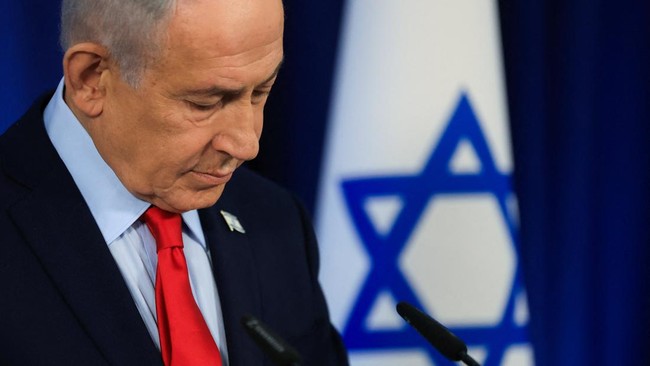
Jakarta, CNBC Indonesia - More than six weeks since the war against Iran began, Israeli Prime Minister Benjamin Netanyahu’s grand ambitions for a historic victory are instead confronting a reality far from expectations. Rather than yielding a decisive win, the conflict, waged alongside the United States, has yet to translate into domestic political gains.
From the outset, this war has been touted as a moment for Netanyahu to cement his place in history. However, despite Israel deploying significant military force, the results on the ground show that its enemies across various fronts have indeed been weakened but not fully neutralised.
Iran remains resilient and defiant, even after massive airstrikes by Israel and the US, and the deaths of several key figures. Tehran’s nuclear stockpiles are still present, its missile capabilities have proven effective, and its influence over the Strait of Hormuz—a vital route for about one-fifth of the world’s oil flow—remains strong.
On other fronts, the Palestinian militant group Hamas has not been disarmed in Gaza. Meanwhile, Iran-backed Hezbollah continues to launch rockets into northern Israel from Lebanon.
“Netanyahu is not winning,” said Danny Citrinowicz, a senior Iran researcher at Israel’s Institute for National Security Studies, as reported by CNN International on Wednesday (15/4/2026).
“This war is a strategic failure. There is a gap between what he promised at the start of the campaign and the final conditions we are experiencing,” he added.
Declining Popularity, Rising Political Risks
According to regional political analysts, Netanyahu now faces a political price for a military campaign that has produced no clear results. Public support for him continues to decline, while legislative elections are scheduled by October at the latest.
Netanyahu, now 76 years old, has not issued an official response to requests for comment on the situation. However, he previously rejected claims that Israel has failed to meet its targets.
“There are major achievements here. This is a historic change. We have destroyed the nuclear programme. We have destroyed the missiles. We have destroyed the regime,” he said in a statement over the weekend.
At the war’s outset, Netanyahu even called on the Iranian people to take to the streets and overthrow the clerical government. However, Israeli security officials are now increasingly sceptical that such a scenario will materialise anytime soon.
Two Israeli officials noted that the operation was initially expected to last only about three weeks to “get the job done.” In reality, the conflict has expanded into a broader confrontation with regional and global implications.
Air Power Not Enough
Former Netanyahu adviser Aviv Bushinsky believes the war initially boosted Netanyahu’s image, particularly after the Hamas attack on 7 October 2023 that sparked the Gaza war. However, that effect has not lasted.
A survey by Agam Labs at the Hebrew University of Jerusalem on 11 April showed that only 10% of Israelis consider the war successful. Support for Netanyahu has dropped to 34%, from 40% at the conflict’s start. More than half of respondents rated his leadership as poor or very poor.
Analysts argue that while the air-based military campaign, using fighter jets like the F-15 and F-35, has shown tactical successes, it has not produced a clear and sustainable endgame strategy.
“There was an assumption that F-15s and F-35s could reshape the Middle East, that if enough Iranian leaders were killed, the regime would collapse,” said Citrinowicz. “That was a mistaken assumption, and the costs it has incurred continue to rise each time.”
Bushinsky also questioned the effectiveness of targeted assassinations, even after Iran’s Supreme Leader Ali Khamenei was among those killed in the strikes.
“There is always someone to replace them,” he asserted. “It wakes the bear, rather than killing it.”
Diplomatic Tensions and War Costs
Western sources and Israeli officials revealed that Netanyahu only learned of the Pakistan-mediated ceasefire plan when it was nearly complete. This reportedly angered him, as he felt excluded from the process.
Since then, Netanyahu has sought to counter the impression that he has been sidelined from diplomacy. He even stated that US Vice President JD Vance contacted him directly to brief him on the talks.
On the other hand, Netanyahu has launched a campaign to convince the public that the war is worth fighting. However, the costs are not insignificant. Israel’s Ministry of Finance stated that the war has consumed around US$11.5 billion from the state budget, mostly for defence needs.
Strategic Dilemma and Regional Risks
Regional diplomats believe Netanyahu’s dilemma will deepen without a decisive military victory. Security threats still loom over Israel, both in Gaza, the West Bank, and in the ongoing conflict with Lebanon.
Netanyahu is said to potentially seek to obstruct diplomatic breakthroughs with Iran, as a US-Iran agreement could worsen his domestic political position.
Israel has stated it is willing to accept a deal that limits Iran’s nuclear and missile programmes and removes enriched uranium.
However, experts believe the war has altered the balance of power. Iran now feels capable of withstanding US military pressure while threatening its adversaries through attacks on energy infrastructure in the Gulf and control over the Strait of Hormuz.
“You can’t put the genie back in the bottle,” said Citrinowicz. “The Iranian side feels stronger now; they feel bolder and they want more than what was offered in previous talks.”