
Iran War Becomes Red Carpet for Yuan, Time for Xi Jinping to Destroy the Dollar
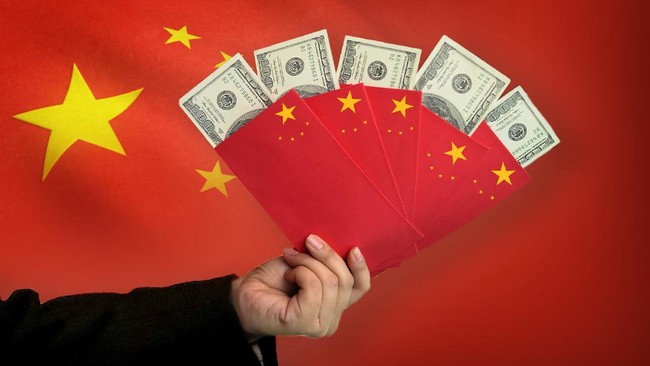
The Iran war is not only shaking markets but also testing the petrodollar and opening space for petroyuan in global oil trade.
Citing the latest report from Deutsche Bank Research Institute, the conflict involving the United States (US) with Iran could become a storm for the petrodollar. This means the war arrives at a time when the old dollar foundation is already facing pressure, and the Iran conflict amplifies that pressure from multiple directions at once.
So far, the dollar’s strength is not just because of the large US economy or its deep financial markets. There is a more fundamental reason, namely that much of world trade is conducted in dollars, and the surplus funds from that trade are also largely stored back in dollar assets. In Deutsche Bank’s view, one of the most important supports for this system is the fact that world oil has mostly been traded in US dollars.
Petrodollar Under Test
Usually, when war breaks out or global tensions rise, the US dollar strengthens. The reason is quite simple. In times of market uncertainty, investors tend to seek safe assets, and the dollar is often the top choice. However, this time the story does not stop at short-term market reactions.
What is more important to note is the long-term impact on the dollar’s position in the global financial system.
So far, the dollar remains dominant because the world still uses it extensively in international trade and stores surplus funds in dollar assets. Therefore, the Iran conflict is seen not merely as triggering risk-off sentiment but also as potentially testing the long-term foundations of dollar dominance.
One of the main pillars of that dominance is the petrodollar, namely the condition where world oil is mostly priced and paid for in US dollars.
Because oil is vital for transportation, industry, fertilisers, petrochemicals, and even factory and office operations, the use of dollars in oil trade also expands the use of dollars in general trade of goods and services.
Simply put, when many countries must use dollars to buy energy, the dollar automatically becomes very important in the world trade system. From there, the dollar’s role grows stronger, not just in financial markets but also in daily economic activities in many countries.
This system is rooted in the old arrangement between the US and Saudi Arabia in 1974.
In that scheme, Saudi Arabia sells oil in US dollars and places the surplus from its sales into dollar assets, particularly US Treasuries. In return, the US provides security guarantees and military protection. Other Gulf countries then followed the same pattern. This arrangement is one of the strong reasons for the dollar’s status as the world’s reserve currency.
Nevertheless, pressure on the petrodollar has actually emerged even before the Iran conflict heated up. This means the war is not the start of the problem but a factor that could accelerate changes already underway.
One cause is the shift in global oil trade directions. Now, most Middle Eastern oil is sold more to Asia than to the US.
Saudi Arabia even now sells oil to China about four times more than to the US. This shows the centre of global energy trade is beginning to shift.
In addition, oil from Russia and Iran, which are under sanctions, has already been widely traded outside the dollar route.
Those oil transactions are conducted in various local currencies such as the rouble, yuan, and rupee, as well as using non-dollar payment infrastructures. This indicates that alternative routes outside the dollar are already forming.
Saudi Arabia is also strengthening its domestic defences and exploring non-dollar payment infrastructures, including through projects like Project mBridge. All this signals that the old petrodollar foundation is no longer as strong as before.
The current conflict is shaking the core of that old scheme, namely the relationship between security and oil trade in dollars. So far, the petrodollar system has endured partly because of US security guarantees in the Gulf region, which is one of the world’s main oil production centres.
However, in this war, those security guarantees are being tested.
US military bases in the Gulf region are reportedly facing attacks from Iran, causing many oil infrastructures to be affected, and the US’s ability to guarantee global oil shipping security is being questioned after trade flows through the Strait of Hormuz are disrupted.
If security guarantees start to waver, the foundations of the old system supporting the petrodollar also weaken.
Damage to the economies of Gulf countries could also push them to liquidate some of their foreign savings, which have long been held mostly in dollar assets. If that happens, pressure on the dollar could come from another side, not just from energy trade.
This conflict is becoming more sensitive because it touches the Strait of Hormuz, one of the most important routes for world oil trade. If this route is disrupted, global energy distribution could be shaken, triggering chain effects on oil prices, inflation, and world financial markets.
In the current situation, the Hormuz route is no longer solely determined by US-led maritime security but is increasingly influenced by direct diplomacy between countries.
Several tankers heading to China, India, and Japan can still pass through. This shows that bilateral relations are starting to play an important role in determining the smooth flow of oil.
At this point, a major change is evident that needs attention. If the smoothness of energy routes is increasingly determined by direct agreements between countries, then the power of the old system, which has long relied heavily on the US, could also diminish.
Yuan Entering the Radar, Petroyuan Starting to be Discussed
Iran is said to be opening opportunities for its allies