
Iran Targets Iraqi Kurdish Headquarters to Thwart Infiltration by Foreign Puppets
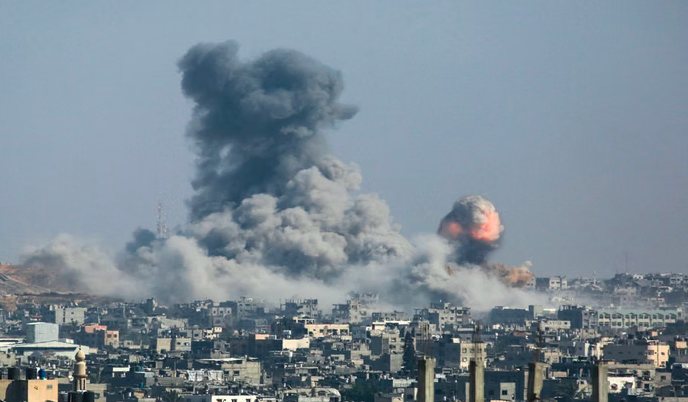
Iranian forces have carried out operations targeting Kurdish groups in Iraq’s semi-autonomous region, alongside a sixth day of missile and drone strikes against Israel and US assets in the Middle East as the regional conflict broadens. Press TV reported that the Iranian military targeted anti-Iran separatist forces, without naming locations. Iran’s Intelligence Ministry confirmed it targeted positions of “separatist” groups intending to advance across the western border, saying the operations inflicted heavy losses. The ministry statement, broadcast by state media, said Iranian forces worked with “noble Kurds” to thwart Israel-US plans to attack Iran.
The new strikes against Kurdish areas in semi-autonomous Iraq came about a week after the start of the US-Israel war against Iran, which has killed at least 1,045 people in the country since Saturday, according to Tasnim News Agency. A video posted to X by Press TV shows an explosion lighting up the night sky during the operation.
Earlier, multiple blasts were reported in the northern Iraqi province of Sulaymaniyah. Local media said at least four explosions were audible near areas Arbat, Zarquiz, and Surdash. Local sources said the attack targeted the headquarters of the Kurdistan Labour Association, or Komala, an Iranian Kurdish insurgent group in Iraq.
The attacks occurred as Kurdish Iranian armed groups have reportedly consulted with the US in recent days about whether and how to attack Iranian security forces in western Iran and what support they might receive from Washington. According to Reuters, the Iranian Kurdish coalition comprising groups based on the Iran–Iraq border has trained to carry out such attacks in order to undermine the country’s military.
The Iraqi Kurdistan regional government on Thursday denied involvement in any plan to arm Kurdish groups and send them into Iran. Nechirvan Barzani, president of the semi-autonomous region, said the area “must not become part of any conflict or military escalation that endangers the lives and security of our citizens.” He added that protecting the territorial integrity of the Kurdistan Region and constitutional gains could only be achieved through unity and national responsibility among all forces and political components.
In a statement cited by Reuters, a spokesman for the Kurdistan Regional Government said it was not involved in any effort to widen the war or worsen regional tensions.
Alongside the strikes on Kurdish groups, the Islamic Revolutionary Guard Corps (IRGC) announced a new round of attacks on Israel and US assets in the Middle East on Thursday morning. Israel’s air defence system intercepted two drones over the western Galilee, Channel 12 reported. Saudi Arabia said it had intercepted at least three drones, while Qatar ordered evacuations around the US Embassy in Doha.
Meanwhile, the US and Israel continued to bombard Iran with explosions rocking Tehran and Kurdish cities Sanandaj, Saqqez, and Bukan. On Monday morning, Israel confirmed a new wave of strikes against Iran, with a spokesperson saying its air force “attacked and destroyed” a ballistic missile platform ready to launch from the city of Qom in Iran. CENTCOM said it aimed to “neutralise” Iran’s mobile missile launch capability. In response, Iran activated its air defences, Tasnim reported. “Since midnight, we’ve seen another wave of attacks begin, and an hour ago, we heard a loud explosion from the east of the capital, and we could even feel the shockwave where we are,” said Tohid Asadi of Al Jazeera, reporting from Tehran. It was not yet clear what was targeted; there were also attacks on Kurdish cities Sanandaj, Saqqez, and Bukan. Overall, more than 150 cities in Iran have been targeted since Saturday.
Asadi said that “the majority” of Tehran residents had decided to flee the capital, though many remained. “They live amid all these concerns, frustration, and fear.”