
Iran Suddenly Grows Tense From Within as Elites Worry Over the President's Stance
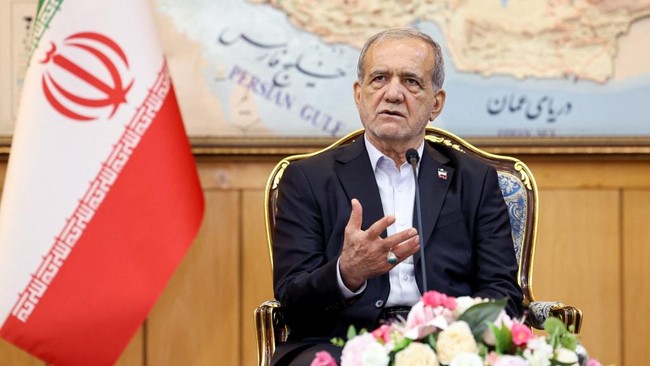
Jakarta, CNBC Indonesia - The mounting military pressure from the United States and Israel is not only jolting Iran’s armed forces but also triggering a serious rift within the upper echelons of the country’s power circle. Indications of a split between hardline groups and more pragmatic factions are beginning to emerge publicly, particularly after the polemic surrounding President Masoud Pezeshkian’s statements about Gulf states.
Tensions among Iran’s elites became even clearer after the death of Supreme Leader Ayatollah Ali Khamenei in a military strike carried out a week earlier. For decades, differences among elite groups could usually be contained by Khamenei’s strong leadership. But his death opened space for internal debate long suppressed.
The conflict with the US and Israel also heightens pressure on the Islamic Republic of Iran. The ongoing air strikes are seen as threatening the survival of Iran’s political system, thus pushing the most militant group within the state structure, the Islamic Revolutionary Guard Corps (IRGC), to play a larger role in determining war strategies.
Meanwhile, that elite force has also been hit by campaigns targeting its senior figures. Several senior commanders were reported killed in military operations conducted by the US and Israel.
Several sources close to Iran’s leadership told Reuters that the pressure is beginning to cause tensions among top figures still surviving after the series of assassinations in the military strikes.
Polemics over the Statements
One of the clearest signs of internal fracture appeared after President Masoud Pezeshkian expressed apologies to Gulf states for the attacks that took place over the past week in their region. He also promised to refrain from similar attacks in the future.
The statement provoked a hardline reaction from groups within the IRGC and the clerical elite. The pressure ultimately forced Pezeshkian to retreat modestly from his initial stance.
In one of the most open criticisms of the president, hardline cleric and MP Hamid Rasai voiced his condemnation via social media.
“Your stance is unprofessional, weak, and unacceptable,” Rasai wrote, chiding the president’s position.
Not long after, when Pezeshkian reposted a similar statement on social media, he no longer included the apology that previously provoked the hardline figures’ anger. The move was seen as a rather embarrassing retreat amid internal pressure.
Nevertheless, senior figures within Iran’s power structure continue to show unity in defending the Islamic Republic from US and Israeli attacks. The rift that has emerged relates more to strategic approaches to facing the conflict.
Two senior sources say that for some time the Iranian government has tended to emphasise differences between moderate and hardline groups as a diplomatic tactic in negotiations with the West. But in the Pezeshkian statement case, the differences that have emerged appear to reflect real tension.
A hardline figure close to Khamenei’s office told Reuters that the president’s comments have angered many senior IRGC commanders.
Meanwhile, another Iranian source, a former moderate official, assessed that there is no figure who can truly replace Khamenei. He described the recently deceased leader as a tough strategist who steered Iran through a succession of severe crises over many years.
New Leadership
Against the backdrop of rising anxiety among Iran’s political elites, senior ayatollahs are now pushing for a quick appointment of a new Supreme Leader.
The clerical body responsible for selecting the Supreme Leader is reportedly speeding up the process, with a decision possibly to be taken on Sunday. However, it remains unclear whether the successor to Khamenei will possess sufficient authority to quell factional conflicts.
Khamenei’s son, Mojtaba Khamenei, is described as one of the strongest candidates. He is believed to enjoy the support of the IRGC and the strong network around his father’s office.
But his position is not entirely secure. Mojtaba is still relatively young compared with many of Iran’s senior ayatollahs, and is considered politically untested. He is also said to have unsettled some moderates within the power structure.
Other potential candidates are also expected to face challenges in maintaining full loyalty from the IRGC, which remains a critical element in preserving the stability of Iran’s political system.
Alex Vatanka, senior fellow at the Middle East Institute, said that wartime conditions tend to clarify who really holds power.
“War tends to elucidate the power structure, and in this case the decisive voice is not the civilian leadership’s but the IRGC’s,” he said.
Strains in the Leadership Body
Iran’s political system has a unique structure. The president, government, and parliament elected by popular vote operate under the authority of a Supreme Leader appointed by the clergy.
The Supreme Leader wields the greatest authority in the country, including direct oversight of the IRGC and various other important institutions.
For 36 years, Khamenei has balanced the hardline and moderate camps within Iran’s power structure. He allowed both camps to express their differences but retained final decision-making authority.
Following his death, interim leadership was formally handed to a transition council comprising President Pezeshkian, the head of the institution.