
Iran Responds to Trump's Victory Claim, Military Strategy Becomes Increasingly Unclear
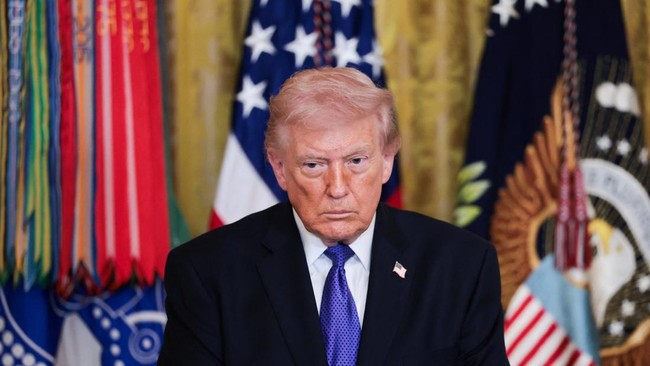
Signals of a policy shift are emerging from Washington amid the war that continues to shake the Middle East. United States President Donald Trump stated that his side is considering reducing military operations against Iran after claiming victory, though he firmly rejected the option of a ceasefire.
In his statement on Friday (19/3/2026), Trump said the United States is “getting closer to achieving our goals as we consider gradually ending our major military efforts in the Middle East.” That statement on the Truth Social platform became the strongest indication so far that Washington is opening the door to ending the conflict that has lasted three weeks.
However, just moments earlier, Trump had emphasised a different stance when speaking to reporters at the White House.
“I think we’ve won,” said Trump, quoted by AFP. “I don’t want a ceasefire. You know, you don’t do a ceasefire when you’re really destroying the opposing side.”
On the other side, Iran’s new Supreme Leader Mojtaba Khamenei claimed that his country has successfully delivered a crushing blow to the enemy. In a written message for Nowruz, the Persian New Year celebration, he said Iran has given a “dizzying blow” to its opponents.
“We have delivered a dizzying blow to the enemy so that now it is starting to utter contradictory words and empty talk.”
Khamenei also stressed that internal unity in Iran is key.
“At this time, thanks to the special unity that has been created among you, our fellow citizens … the enemy has been defeated,” he said.
That statement came amid a situation in Tehran still gripped by tension. New explosions were reported in Iran’s capital on Friday, even as residents tried to celebrate Nowruz.
Shopping activity remained visible, though not as bustling as usual because many residents chose to leave the city.
Widespread Attacks, Holy Sites Affected
The war that began on 28 February continues to widen. Israel accused Iran of attacking holy sites in Jerusalem after an explosion created a crater in the Old City, near the Al-Aqsa Mosque, the Western Wall, and the Church of the Holy Sepulchre.
At the same time, tensions are also spreading to other countries. Turkey condemned Israel’s attack on a Syrian military camp in the south, calling it a “dangerous escalation” and urging the international community to intervene.
Syria itself has so far been relatively spared from direct conflict, though the war has involved many countries in the region. Meanwhile, Lebanon has also been affected by Israeli airstrikes targeting Hezbollah, Iran’s ally. Lebanon’s Health Ministry stated that more than 1,000 people have been killed.
Global Energy Routes Threatened
In the energy sector, the war’s impact is increasingly felt. Iran is said to have effectively blockaded the Strait of Hormuz, a vital route through which around 20% of the world’s crude oil and liquefied natural gas supplies pass under normal conditions.
Trump even stated that securing that route is no longer the United States’ responsibility.
“The Strait of Hormuz must be guarded and monitored by other countries that use it - not the United States!” he said.
“If asked, we will help those countries in their efforts in Hormuz, but that should not be necessary after the Iranian threat is eliminated.”
Trump also revealed that Washington actually wants to open dialogue with Tehran, but the current situation makes it difficult.
“No one can be talked to,” he said, referring to the deaths of several high-ranking Iranian officials, including the previous leader Ali Khamenei.
Uncertainty in Military Strategy
Although hinting at reducing operations, Trump did not rule out further military steps. A Wall Street Journal report mentioned that an additional 2,200 to 2,500 US Marines are being sent to the region.
When asked about the possibility of occupying or blockading Kharg Island, Iran’s oil export hub, Trump gave a brief answer: “I may have a plan or maybe not.”
US forces had previously attacked the island and, according to Trump, “completely destroyed” all military targets there. However, Washington has so far avoided directly attacking oil infrastructure.
Meanwhile, Iran continues to launch attacks on energy infrastructure in the Gulf region. A drone attack hit the large Mina Al-Ahmadi oil refinery in Kuwait and sparked a fire that was later brought under control.
The day before, a major natural gas facility in Ras Laffan, Qatar, was also directly hit. Qatar’s state energy company described the damage as “major damage” that could potentially cause losses of up to US$20 billion per year and require 5 years for repairs.