
Iran Reopens Strait of Hormuz, But the Actual Situation on Site is Different
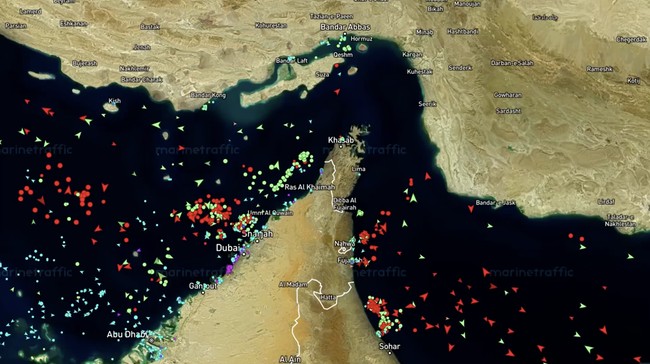
In the midst of news about the reopening of the world’s most vital energy route, the movement of merchant ships instead shows a different picture. They are hesitant, stopping, or even turning back before reaching their destination.
According to Reuters, several ships were reported to have failed to exit the Gulf region on Friday night (17/4/2026), according to shipping tracking data, even though Iran has announced that the Strait of Hormuz has been reopened during the 10-day ceasefire in Lebanon.
Tehran’s announcement previously had an immediate impact on global markets, where oil prices and other commodities fell, while stock exchanges strengthened. However, on the ground, the situation has not fully recovered.
Data from MarineTraffic shows that around 20 ships were moving towards the Strait of Hormuz on Friday night. However, shortly afterwards, most stopped their journey, and some even turned back.
This is the largest group of ships to attempt to pass since Iran effectively closed the strait in response to attacks by the United States and Israel that began on 28 February.
The exact reason why these ships stopped sailing remains unclear. Among the fleet were three container ships operated by CMA CGM, which chose not to comment.
By 9:00 p.m. local time, the majority of ships in that group had turned back. Nevertheless, tracking data shows that a number of new ships, particularly tankers, are still attempting to approach the strait.
Permission to Pass, But Not Free of Risk
Shipping companies are welcoming the opening of the strait with caution. They assess that more clarity is still needed before truly returning to normal operations, especially regarding security risks such as the possibility of sea mines.
A senior Iranian official said that all commercial ships, including those flying the US flag, are permitted to pass. However, shipping plans must be coordinated with Iran’s Revolutionary Guard Corps (IRGC).
He added that ships are only allowed to pass through routes deemed safe by Iran, while military ships remain prohibited from passing.
The Secretary-General of the International Maritime Organization, Arsenio Dominguez, emphasised that his organisation is still verifying the announcement.
“Currently, we are verifying the latest announcement regarding the reopening of the Strait of Hormuz, in terms of its compliance with freedom of navigation for all merchant ships and safe shipping lanes,” it was noted.
Uncertainty Still Looms
Although there are positive signals, industry players assess that the situation is still far from safe. The Norwegian Shipowners’ Association mentioned that several crucial issues remain unresolved, including the presence of mines, Iran’s conditions, and how those rules are implemented on the ground.
“If this is a step towards opening, then this is a welcome development,” said the association’s CEO, Knut Arild Hareide.
The international shipping group BIMCO even warned its members not to rush back to passing through, given the unclear mine threat. Similar warnings came from the US Navy, which mentioned serious risks on that route.
German shipping company Hapag-Lloyd stated that it is working to resume sailing “as soon as possible”, but acknowledged that many questions remain unanswered.
Meanwhile, Danish company Maersk said it continues to monitor the situation developments closely. Norwegian tanker company Frontline chose not to comment.
Shipping analyst from Kpler, Matt Wright, assessed that uncertainty also encompasses which routes are actually safe for ships to use to exit the Gulf.
He highlighted the new route imposed by Tehran through its territorial waters near Larak Island. According to him, that route still poses navigation challenges, even if ships are not charged fees, and raises questions regarding compliance and insurance.