
Iran on High Alert for War Against US, Bulk-Purchases Chinese Supersonic Missiles
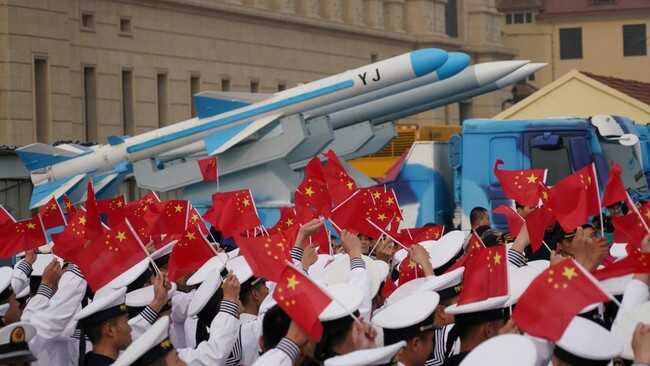
Iran is reported to be on the verge of concluding an agreement with China for the purchase of supersonic anti-ship cruise missiles amid escalating military tensions with the United States. This step comes as Washington deploys substantial naval forces near Iran’s coastline in preparation for potential military action against the nation.
According to six sources familiar with the negotiations, the agreement for China-made CM-302 missiles is nearly finalised, although the delivery date remains undecided. These supersonic missiles have a range of approximately 290 kilometres and are designed to evade warship defences by flying low and at extremely high speeds.
Two weapons experts stated that the deployment of these missiles would significantly enhance Iran’s attack capabilities, posing a serious threat to US naval forces in the region.
Negotiations for this missile weapons system actually began at least two years ago but accelerated sharply following the 12-day conflict between Israel and Iran last June. Three officials briefed by the Iranian government and three security officials stated that talks entered their final phase in the summer, marked by a visit from senior Iranian military officials, including Deputy Defence Minister Massoud Oraei, to China.
“This would be a complete game-changer if Iran possesses supersonic attack capabilities against ships in the area. These missiles are extremely difficult to intercept,” said Danny Citrinowicz, a former Israeli intelligence officer now a senior Iran researcher at the Institute for National Security Studies, in comments to Reuters.
To date, the number of missile units involved in the agreement or the contract value remains unclear. An Iranian Foreign Ministry official gave positive signals regarding this defence cooperation to Reuters.
“Iran has military and security agreements with its allies, and now is the right time to utilise those agreements,” the Iranian Foreign Ministry official stated.
China, meanwhile, has responded more cautiously. In a statement following the report’s emergence, China’s Foreign Ministry stated it was unaware of discussions regarding the potential sale of these missiles.
“The ministry is unaware of any discussions regarding the reported potential sale of missiles,” the Chinese Foreign Ministry’s official statement read.
The White House did not directly respond to details of the Iran-China negotiations. However, a White House official emphasised the firm position of President Donald Trump, who has given Tehran an ultimatum.
“President Donald Trump has made clear that his options are either we reach a deal or we have to do something very tough, like we did last time,” a White House official said, referring to current tensions.
The CM-302 will be the most advanced military hardware China has ever transferred to Iran, whilst also challenging the UN arms embargo that was reinstituted last September. This sale is seen as likely to complicate US efforts to limit Iran’s missile and nuclear programmes and signals China’s desire to assert its influence in a region long dominated by US military presence.
China’s Diplomatic Support for Iran
China’s diplomatic support for Iran was evident when President Xi Jinping hosted Iranian President Masoud Pezeshkian in Beijing last September. During that meeting, Xi provided assurances of strong political backing.
“China supports Iran in safeguarding its sovereignty, territorial integrity, and national dignity,” Xi Jinping told the Iranian leader.
China’s involvement in strengthening Iran’s defence is viewed by some as part of broader geopolitical competition. Iran is now regarded as a meeting point in the confrontation between major world powers.
“Iran has become a battlefield between the US on one side and Russia and China on the other,” said one official briefed on the missile negotiations.
The deployment of these missiles occurs as the US assembles a battle fleet within striking distance of Iran, including the aircraft carriers USS Abraham Lincoln and USS Gerald R. Ford, carrying thousands of personnel and hundreds of aircraft. Citrinowicz added that China has strategic interests in maintaining the stability of the current regime in Tehran.
“China does not want to see a pro-Western regime in Iran. That would threaten their interests. They hope this regime will endure,” Citrinowicz added.
Iran’s efforts to update its weapons systems are also driven by its depleting arsenal following last year’s conflicts. Pieter Wezeman, a senior researcher at the Stockholm International Peace Research Institute, described the CM-302 purchase as a significant upgrade for Iran.
“This weapons system can be mounted on ships, aircraft, or mobile ground vehicles, and is even capable of sinking aircraft carriers or destroyers,” according to information in the product marketing by the China Aerospace Science and Industry Corporation (CASIC).
Beyond anti-ship missiles, sources indicate Iran is also discussing the acquisition of surface-to-air missile systems, anti-ballistic weapons, and anti-satellite weapons from China. Whilst China had reduced large-scale weapons transfers to Iran in the late 1990s due to international pressure, military relations between the two nations have now intensified amid rising global tensions.