
Iran Crisis: US Dollar Surges as Asian Currencies Falter
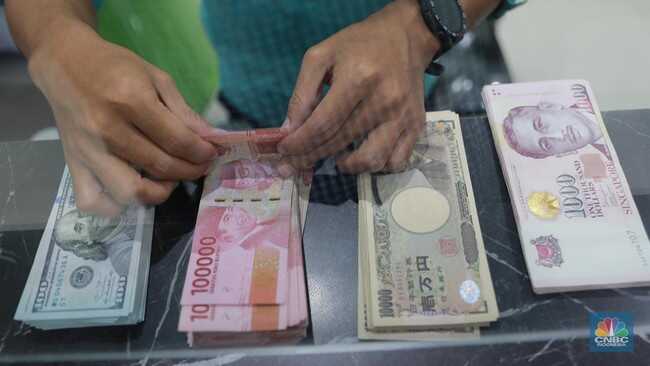
Asian currencies weakened uniformly during morning trading on Monday, 2 March 2026, under pressure from the strengthening US dollar, as markets reacted to escalating geopolitical tensions in the Middle East following US and Israeli strikes on Iran on Saturday, 28 February 2026.
According to Refinitiv data, as of 09:20 WIB, eleven Asian currencies tracked all showed weakness against the greenback.
The deepest decline occurred in the South Korean won, which depreciated 0.82% to KRW 1,450.99/US.TheThaibahtfollowedwitha0.68.
The Indonesian rupiah also fell into negative territory, declining 0.45% to Rp16,835/US$, marking the third-deepest depreciation among Asian currencies this morning.
The Philippine peso followed suit with a sharp 0.41% correction to PHP 57.878/US.Malaysia, ourneighbouringcountry, alsoexperiencedcurrencyweakness, withtheringgitdepreciating0.39.
Pressure also mounted on several other Asian currencies. The Vietnamese dong and Singapore dollar both fell 0.24% each, reaching VND 26,102/US$ and SGD 1.2675/US$ respectively.
The Japanese yen weakened 0.23% to JPY 156.41/US, theIndianrupeedeclined0.21, and the Chinese yuan corrected 0.19% to CNY 6.87/US$.
The Taiwan dollar recorded the mildest depreciation, falling 0.16% to TWD 31.425/US$.
This movement aligned with the strengthening of the US Dollar Index (DXY). At the same time, the DXY rose 0.27% to 97.869.
The strengthening of the dollar index reflected increased investor demand for US dollar-denominated assets, which placed downward pressure on the majority of other currencies, including Asian currencies.
From an external perspective, the US dollar’s appreciation occurred amid heightened demand for safe-haven assets following US and Israeli strikes on Iran over the weekend. The conflict triggered global market concerns due to its potential to escalate geopolitical tensions in the Middle East region, including disruptions to maritime traffic in the oil-rich Gulf area.
Additionally, Iran reportedly launched attacks against US assets in several surrounding nations, including the United Arab Emirates, Bahrain, Kuwait, Qatar, Saudi Arabia, Jordan, Iraq, and Syria.
This situation prompted market participants to pursue the US dollar as a safe asset, thereby supporting the DXY’s strengthening and suppressing the movement of the majority of Asian currencies during morning trading.