
IPB Professor Offers Solution for Eradicating Sailfin Catfish
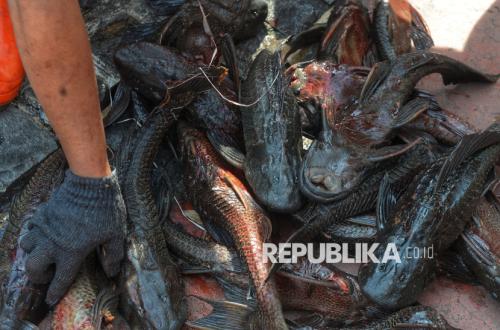
Professor of Fishery Product Technology at the Faculty of Fisheries and Marine Sciences, IPB University, Prof Mala Nurilmala, has offered a solution for eradicating the sailfin catfish that has been widely discussed. She encourages the results of the pleco eradication to be turned into fertiliser for ornamental plants. Prof Mala regrets the method used by the DKI Jakarta Provincial Government, which previously buried the sailfin catfish alive during the eradication operation, deeming it to have no benefits. Nevertheless, this MUI Halal Auditor views the operation as highly positive and falling under the category of force majeure in the context of environmental ecosystem balance. “The sailfin catfish should preferably be utilised as liquid fertiliser for ornamental plants. Indeed, it cannot be used for living beings anymore because it is in waters heavily polluted with heavy metals,” said Prof Mala in her statement quoted from MUIDigital, Saturday (25/4/2026). The Director of InCoPro (Indonesian aquatic co-product association) reminds that the sailfin catfish in Jakarta’s river waters are already contaminated with heavy metals, making them unsafe for use with living beings. “Not only for human consumption, but also if the sailfin catfish from polluted Jakarta waters are used as feed for livestock such as chickens and ducks,” said this Senior Researcher at the IPB Halal Science Center. She stated that if sailfin catfish are in unpolluted waters, they are like ordinary fish that are safe for human consumption and as livestock feed. “Actually, sailfin catfish, if there is an ecosystem balancer, can preserve the environment and be beneficial in absorbing metals. But here, there is no food, no other predators, so they multiply excessively and even damage the environment because the ecosystem is absent,” she explained. Prof Mala explained that sailfin catfish are fish that can adapt well to all conditions. Therefore, she believes that eradicating sailfin catfish needs to be utilised rather than buried, especially buried alive. Prof Mala highlighted Minamata disease, caused by tuna heavily contaminated with mercury, leading to various cases in humans. “Contaminated fish become part of the food chain. For example, this fish is eaten by animals, introducing heavy metals. Those animals are then eaten by humans accumulatively, causing harm,” she said. Prof Mala also reminded that if sailfin catfish are buried, the decomposition process will take a long time because sailfin catfish have very hard shells. Previously, the MUI Fatwa Commission responded to the sailfin catfish eradication operation by the DKI Jakarta Provincial Government, which was suspected of burying the fish while they were still alive. Secretary of the MUI Fatwa Commission, KH Miftahul Huda, reminded that the mass burial of live sailfin catfish violates two principles. First, the principle of rahmatan lil ’alamin and the principle of animal welfare or kesrawan (animal welfare).