
Investment Ministry Revises Three Business Licensing Regulations to Accelerate Investment and Support 8% Growth Target
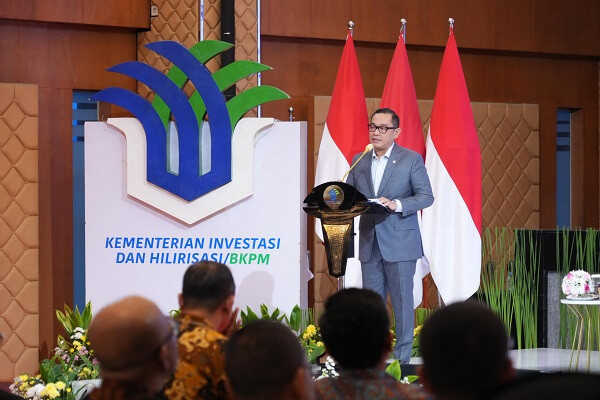
JAKARTA - The Ministry of Investment and Downstream Industries/Investment Coordinating Board (BKPM) is revising three implementing regulations of Government Regulation Number 5 of 2021 on Risk-Based Business Licensing. The move aims to accelerate investment realisation and support the ambitious national economic growth target of 8% by 2029.
Deputy Minister of Investment and Downstream Industries/BKPM, Todotua Pasaribu, explained that the three regulations under revision are:
- BKPM Regulation No. 3 of 2021 on the Electronically Integrated Risk-Based Business Licensing System
- BKPM Regulation No. 4 of 2021 on Guidelines and Procedures for Business Licensing Services and Investment Facilities
- BKPM Regulation No. 5 of 2021 on Guidelines and Procedures for Risk-Based Business Licensing Supervision
“The government is targeting economic growth of up to 8%, an ambitious figure, but still realistic if all parties move together,” said Todotua at the Public Consultation on the Draft Revision of the Minister of Investment Regulation on Thursday (3 July 2025).
Todotua revealed that to achieve this economic growth target, Indonesia requires investment realisation of Rp 13,000 trillion over the next five years. By comparison, during the previous administration’s ten years in office, total realised investment reached only approximately Rp 9,900 trillion.
This year, the investment target has been raised to Rp 1,900 trillion, up from the 2024 realisation of Rp 1,700 trillion. In the first quarter of 2025, investment realisation reached Rp 465 trillion, and early reports from the second quarter indicate a stable trend.
Nevertheless, Todotua cautioned about potential challenges in the third and fourth quarters, given persistent classic obstacles such as slow licensing, overlapping policies, and an investment climate that is not yet fully conducive.
“We note that in 2024, unrealised investment potential reached Rp 1,500 to Rp 2,000 trillion, due to licensing issues and policy uncertainty,” he said.
As part of comprehensive reform, the Ministry of Investment under Minister Rosan Roeslani is committed to improving licensing service bureaucracy through regulatory revision and optimisation of the Online Single Submission (OSS) system.
“We want to ensure the licensing process is faster, easier, and provides legal certainty for business operators,” said Todotua.
He emphasised the importance of consolidation among ministries and agencies, particularly as there are currently 1,700 types of licences spread across 17 ministries and agencies. However, the financial industry sector is considered not yet fully integrated into the OSS system.
“We have met with the Chairman of the Financial Services Authority (OJK) to discuss the need for the financial industry, both banking and non-banking, to be incorporated into OSS. So far, the response has been very positive,” he said.
He expressed hope that within the next one to two weeks, an agreement with the OJK could be finalised so that the financial sector is also recorded in the national investment realisation system.
With the active involvement of business operators and cross-sectoral support, this reform is expected to become a significant breakthrough in creating a healthy investment climate whilst driving sustainable economic growth.