
Investment Growth Slows Sharply in Early 2025 Amid Global Uncertainty and Weak Domestic Demand
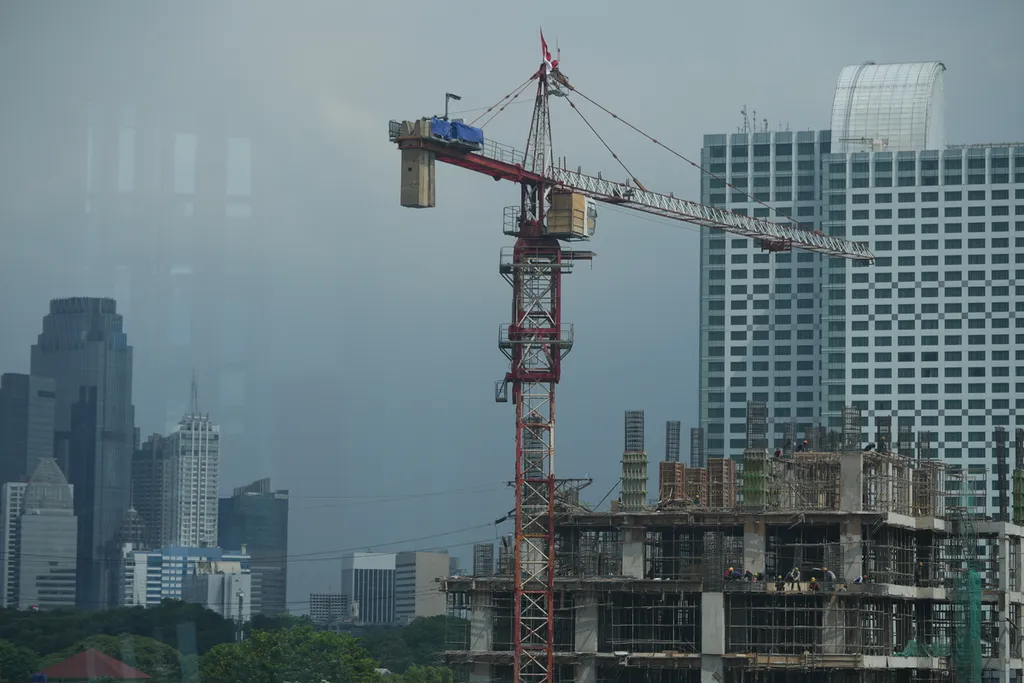
JAKARTA, KOMPAS — Slowing growth in gross fixed capital formation (GFCF), consistent with investment realisation data for the first quarter of 2025, paints a picture of sluggish investment at the start of the year. Global uncertainty, weak domestic demand, and seasonal factors are believed to have hampered investment growth.
The Central Statistics Agency (BPS) recorded that GFCF growth reached only 2.12 per cent year-on-year in the first quarter of 2025. This figure is lower than the 5.03 per cent growth recorded in the fourth quarter of 2024, marking the lowest growth rate in two years.
According to the BPS website, GFCF represents expenditure on capital goods with a useful life exceeding one year that are not consumer goods. GFCF is generally understood as a form of physical investment.
However, GFCF growth figures were lower than the investment data released by the Ministry of Investment and Downstreaming/Investment Coordinating Board (BKPM). BKPM reported that investment realisation, encompassing both foreign direct investment (FDI) and domestic investment, reached Rp 465.2 trillion in the first quarter of 2025, representing 15.9 per cent growth compared with the same period the previous year.
From a growth perspective, there was a deceleration during the first three months of 2025. By comparison, annual investment growth in the first quarter of 2024 stood at 22.1 per cent.
Despite the differing figures, both the BPS-compiled GFCF growth data and the BKPM investment realisation figures point to a slowdown.
Yusuf Rendy Manilet, an economist at the Center of Reform on Economics (Core) Indonesia, assessed that the investment growth slowdown reflected in both datasets indicates disrupted sentiment from external factors. Global uncertainty triggered by the escalation of the United States tariff war is considered likely to dampen investment interest.
He cited the example of economic slowdowns in Indonesia’s major trading partners, such as the US and China, which could suppress demand for Indonesia’s key export commodities, including crude palm oil (CPO) and coal.
“This has been exacerbated by the decline in the energy commodity price index from 100.8 in 2024 to 94.5 in 2025. This price decline not only pressures export revenues but also reduces the attractiveness of the extractive sector for investors,” Yusuf said on Tuesday (6 May 2025).
Beyond external pressures, domestic factors have also contributed to the investment slowdown. Political uncertainty and fiscal policy during the government transition period have led business operators to adopt a wait-and-see approach.
“These conditions have caused many business operators to delay expansion until the policy direction and incentives from the new government become clearer,” Yusuf said.
Echoing Yusuf’s assessment, BPS head Amalia Adininggar Widyasanti stated at a press conference on Monday (5 May 2025) that the GFCF slowdown at the beginning of the year was influenced by highly uncertain global economic conditions. However, she also noted that the first-quarter 2025 slowdown represented a common annual seasonal pattern.
“GFCF was slow because investors were likely still adopting a wait-and-see approach towards global conditions. Typically, the beginning of the year is also relatively subdued,” Amalia said.
BPS records show that over the past five years, GFCF growth has tended to decelerate in the first quarter compared with the fourth quarter of the preceding year. The exception occurred in the first quarter of 2021 when GFCF contracted by 0.21 per cent, which was nonetheless better than the deeper contraction of minus 6.17 per cent in the fourth quarter of 2020.
Intertwined factors
Yusuf emphasised that investment is a crucial component of gross domestic product (GDP) formation. In 2024, investment’s contribution to Indonesia’s GDP reached 29.15 per cent, the second highest after household consumption.
He believes the investment slowdown was one of the primary causes of the deceleration in economic growth at the start of 2025. BPS previously announced that Indonesia’s economy managed to grow only 4.87 per cent year-on-year in the first quarter of 2025.
He added that the factors behind weakening investment and weakening consumption are intertwined. Deflation in January and February 2025 also reflected weak domestic demand. Although technically lowering goods prices, deflation also indicates declining public purchasing power.
“Ultimately, the decline in purchasing power reduces the prospects of the domestic market as an investment destination and also restrains business operators from pursuing greater expansion,” he said.
Yusuf also observed that current global and domestic monetary conditions are driving investors to exercise greater caution in deploying capital. Global uncertainty and rising import prices are prompting several central banks, including the US Federal Reserve, to potentially hold off on interest rate cuts. The Fed is even predicted to cut rates by only 0.5 per cent throughout 2025, lower than previous expectations.
This situation is leading central banks in developing countries such as Indonesia to maintain high interest rates to preserve capital flow stability. The consequence of elevated interest rates is increased borrowing costs, as indicated by the slowdown in bank lending. Credit growth decelerated from 10.3 per cent year-on-year in February to 9.16 per cent in March 2025.
“Although investment credit is still growing at a fairly high rate of 13.36 per cent year-on-year, the slowdown in consumer and working capital credit indicates declining overall economic activity, which ultimately restrains real sector expansion,” Yusuf said.
Previously, at a press conference at the BKPM office in Jakarta on Tuesday (29 April 2025), Minister of Investment and Downstreaming/BKPM head Rosan Roeslani did not explicitly explain the causes behind the investment growth slowdown in the first quarter of 2025. However, he highlighted the importance of improving the investment climate in Indonesia, including by cracking down on “thuggery” that frequently disrupts the business world.
“We are coordinating with the National Police chief and regional governments to ensure these things do not occur, as they have a negative impact on incoming investment,” Rosan said.