
Investment Growth Slows in Q1 2025 Amid Thuggery in Industrial Zones
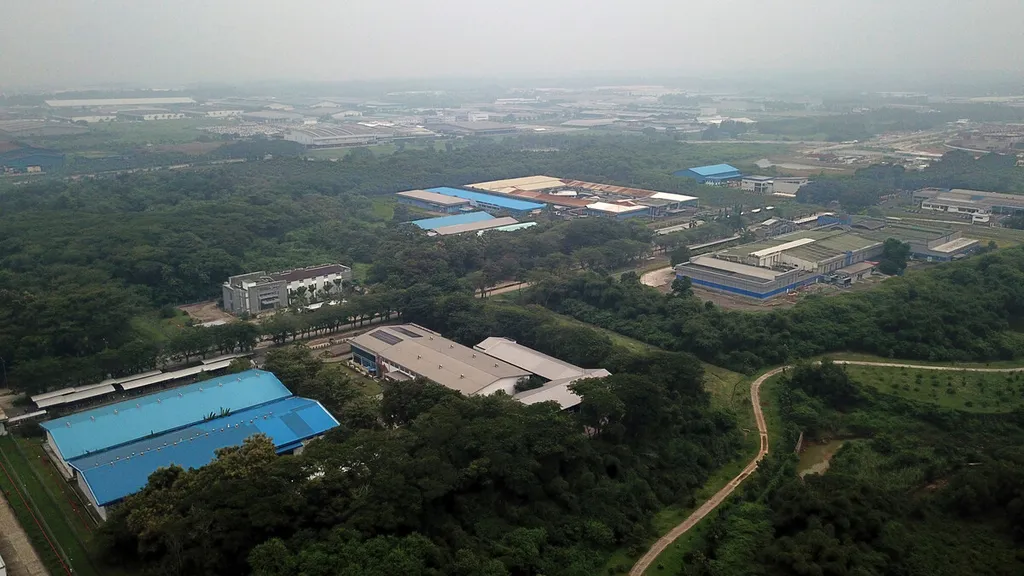
JAKARTA, KOMPAS — Investment realisation in the first three months of 2025 grew at a slower pace compared with the same period the previous year. Besides indicating the continued weakness of incentive effectiveness, the slowdown is also inseparable from the problem of thuggery in industrial zones that has recently come under the spotlight.
The Ministry of Investment and Downstreaming/Investment Coordinating Board (BKPM) recorded that investment realisation in the first quarter of 2025 reached Rp 465.2 trillion. This figure is equivalent to 24.4 per cent of the total 2025 investment target of Rp 1,905.6 trillion.
Investment realisation grew 15.9 per cent year-on-year compared with Q1 2024’s Rp 401.5 trillion. However, in terms of growth, there was a deceleration in the first three months of 2025. By comparison, annual investment growth in Q1 2024 stood at 22.1 per cent.
Of all investment realisation recorded between January and March 2025, 49.5 per cent or Rp 230.4 trillion constituted foreign direct investment (FDI), whilst 50.5 per cent or Rp 234.8 trillion was domestic direct investment (DDI).
BKPM chief and Minister of Investment and Downstreaming Rosan Roeslani, speaking at BKPM headquarters in Jakarta on Tuesday (29/4/2025), stated that total investment inflows in Q1 2025 demonstrated that foreign and domestic investor appetite for investing in Indonesia remained high despite rising geopolitical and geo-economic tensions.
“This is one very good indicator that we should be grateful for. We see that the appetite of both domestic and foreign investors to invest in Indonesia continues to increase,” he said.
Regarding the investment growth slowdown in the first three months of 2025, Rosan highlighted several issues he acknowledged still needed to be addressed to improve the domestic investment climate, including ease of licensing, legal certainty, and the problem of thuggery.
On the specific issue of thuggery, Rosan said he had received complaints from investors. “We are coordinating with the National Police Chief and regional governments to ensure these things do not happen, as they have a negative impact on incoming investment,” Rosan said.
Kompas noted that the construction of the Build Your Dreams (BYD) factory in Subang, West Java, had allegedly been disrupted by mass organisations (ormas). The issue surfaced when Deputy Speaker of the People’s Consultative Assembly (MPR) Eddy Soeparno revealed reports of thuggery disrupting investment and the construction of the BYD factory in Subang.
“Investors must not come to Indonesia and feel they have no security guarantees. Security guarantees are the most fundamental requirement for investment to enter Indonesia,” said Eddy, who made the statement during a visit to a BYD factory in Shenzhen, China.
Beyond these statements, findings from the Kompas investigative team revealed that thuggery in industrial zones has become a serious obstacle to investment. The disruptions occur systematically and involve mass organisations, rogue officials, and village administrators who frequently exploit their positions to pressure companies.
In Indonesia’s industrial zones, thuggery has become a spectre haunting business operators. Various mass organisations and certain groups regularly engage in extortion, intimidation, and factory blockades. Thuggery in industrial zones has in fact been occurring for years on the ground. The difference is that more business operators are now willing to speak out.
A survey conducted by an industrial estate manager in Bekasi showed that 51.1 per cent of respondents felt the primary disruption came from visits by mass organisations. Some companies were visited more than 12 times in a single year by such groups.
Meanwhile, Indonesian Employers’ Association (Apindo) chairwoman Shinta Kamdani expressed hope that the government would take concrete steps to address thuggery, which she said disrupted business operations. “We have also conveyed this to the government. Clearly, this is very disruptive,” Shinta said.
Shinta revealed that the practice of illegal levies systematically carried out by rogue individuals in various regions was not a new phenomenon. Such actions had been occurring for years on the ground. The difference now is that more business operators are willing to speak out about the situation that harms industry and damages the investment climate.
Although she did not cite an exact figure for business losses caused by thuggery, Shinta stressed that illegal levies had a detrimental impact on the domestic investment climate. “We cannot directly translate this into economic costs, but clearly it disrupts the investment ecosystem in Indonesia,” she said.
Incentive Effectiveness
Beyond the investment climate disruption caused by thuggery, Head of the Macroeconomics and Finance Centre at the Institute for Development of Economics and Finance (Indef) Rizal Taufikurahman assessed that the slowdown in investment realisation growth at the start of this year indicated the continued weakness of government investment incentives.
Furthermore, the lack of structural reform and sub-optimal implementation of downstreaming and industrialisation programmes to attract quality investment had also suppressed Indonesia’s investment ratio within its economic structure, which had remained at only around 30 per cent for years.
“Indonesia’s economic structure has long been highly dependent on household consumption at around 55 per cent, followed by investment at around 31 per cent,” he said.
Although the DDI ratio in Q1 2025 was larger than FDI, over the past five years DDI growth has generally not been as aggressive as FDI growth.
By sector, DDI realisation throughout 2024 was dominated by the tertiary sector at 53.1 per cent, encompassing hotels and restaurants, other services, construction, trade and repairs, transport, warehousing, and telecommunications. DDI’s contribution to the secondary sector stood at 23.9 per cent, covering manufacturing. The remainder was the primary sector at 23 per cent, covering forestry, fisheries, mining, food crops, plantations, and livestock.
FDI realisation throughout 2024, meanwhile, was dominated by the secondary sector at 58.5 per cent, followed by the tertiary sector at 29.3 per cent and the primary sector at 12.2 per cent.
“If DDI and FDI contributions to the secondary sector were equal, I believe the strengthening of the economic structure to drive downstreaming and industrialisation would be much faster,” Rizal said.
Furthermore, BKPM data showed that quarterly downstreaming investment realisation in 2024 exhibited a fluctuating pattern with a tendency to increase in Q4 2024, reaching Rp 134.9 trillion after having fallen to Rp 75.8 trillion in Q1 2024.
“This pattern indicates instability in downstreaming investment flows throughout last year, and certainly reflects dependence on certain large projects or a weak sustainable investment pipeline,” Rizal said.