
Interior Minister Urges Public Not to Panic Buy Fuel and Staple Goods
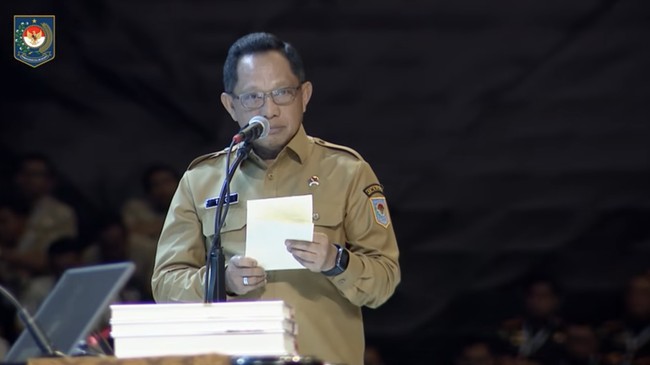
Interior Minister Tito Karnavian has urged the public not to engage in excessive purchasing or panic buying of essential commodities such as fuel and rice, amidst circulating concerns about price increases ahead of Eid al-Fitr in 1447 Hijriah.
The appeal was made in response to public anxiety regarding potential supply shortages and price spikes during the significant religious holiday. The Interior Minister assured the public that stocks of essential commodities are secure and sufficient.
The government has noted that national rice stock currently stands at four million tonnes, whilst fuel supplies are also available in adequate quantities to meet public consumption needs during the Ramadan to Eid period. “The public need not panic buy, as this will only disrupt the food supply chain. The government has schemes in place to address issues of price and supply of essentials,” said the Interior Minister in an official statement, following a coordination meeting with all regional heads across Indonesia at the Wan Seri Beni Hall in Tanjungpinang City, Riau Islands, on 11 March 2026.
Furthermore, Tito urged the public not to be overly concerned about the national economic growth rate for 2025, which was recorded at 4.7 percent. “Last year electricity rates were subsidised, but now prices have stabilised. Meanwhile, our economic calculations still use subsidised electricity rates,” said the Interior Minister.
During the coordination meeting, the Interior Minister instructed all governors, regents, and mayors, particularly in the Riau Islands region, to immediately conduct internal meetings to ensure preparedness of food and energy supplies in their respective areas. According to Tito, this anticipatory measure is important for maintaining smooth supply chain operations to prevent distribution disruptions that could harm consumers. “Regional heads should immediately meet and coordinate with distributors and businesses regarding supply preparedness,” he said.
Member of Commission VI of the Indonesian House of Representatives, Nevi Zuairina, stressed that information regarding fuel operational reserve capacity needs to be explained comprehensively to the public to prevent misunderstandings that could lead to panic buying in various regions. This PKS faction politician emphasised that incomplete public communication can trigger excessive concern.
“When the public hears that fuel stock is only available for around three weeks, some people immediately assume shortages will occur. However, what is meant is the operational reserve capacity in national storage tanks, not that fuel supplies will be depleted within that period,” said Nevi.
She explained that panic buying phenomena are typically triggered by several factors, including information uncertainty, mass psychology, and concerns about global geopolitical situations. She assessed that escalation of international conflicts often sparks public concern about the stability of global energy supplies.
“Often public fear is greater than actual conditions. When some people begin hoarding fuel, others follow suit. This then triggers long queues at petrol stations and disrupts distribution,” she explained.
Nevi added that panic buying can actually create artificial scarcity, which risks disrupting the national energy distribution system and even driving price increases at the public level. She therefore urged the government to strengthen fast, transparent, and data-based public communication. Additionally, distribution stability from refineries to depots to petrol stations must be maintained to ensure smooth supply throughout all regions.
“Oversight of potential fuel hoarding and misuse must also be tightened, especially in situations vulnerable to speculation,” she stressed.