
Integration of FTTH and FWA Becomes Key to Equitable Digital Access
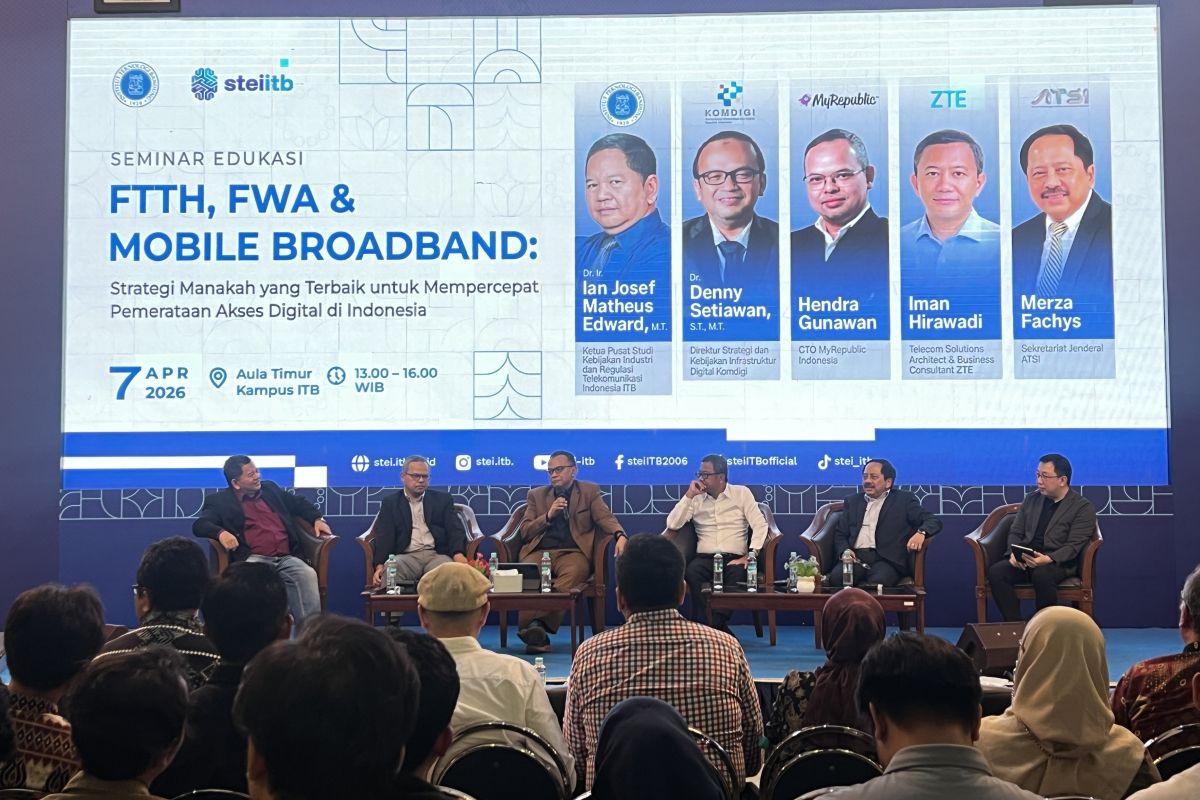
Experts agree that Indonesia’s geographical challenges require the integration of various technologies rather than relying on a single solution. This was evident at a seminar organised by Institut Teknologi Bandung (ITB) to promote national digital literacy, titled ‘FTTH, FWA & Mobile Broadband: Which Strategy is Best for Accelerating Equitable Distribution and Improving Digital Access Performance in Indonesia’, held at the East Auditorium of ITB Campus on Tuesday (7/4).
The seminar spotlighted three main technologies—Fiber to the Home (FTTH), Fixed Wireless Access (FWA), and Mobile Broadband—as pillars of national connectivity. The discussion forum brought together perspectives from academics, regulators, industry practitioners, and technology equipment providers. This approach is expected to provide a comprehensive overview of each technology’s role in the national telecommunications ecosystem, while encouraging the formation of more effective strategies to accelerate equitable digital access in Indonesia.
In the discussion session, Ian Josef Matheus Edward, Chairman of the Indonesian Telecommunication Industry and Regulation Policy Study Centre at STEI ITB, emphasised that no single technology can serve as a complete solution.
‘FTTH offers the best capacity and stability, while FWA provides flexibility and rapid deployment. Both need to be positioned as complementary solutions to expand digital access. Each technology has different characteristics and strengths. Wireless technology excels in ease of deployment, while FTTH remains the primary choice for service quality and reliability,’ he stated.
From the regulator’s perspective, Denny Setiawan, Director of Digital Infrastructure Strategy and Policy at the Ministry of Communication and Digital of the Republic of Indonesia, affirmed the importance of commitment to equitable development.
‘We encourage broadband service development not to focus only on densely populated areas but also to reach underserved regions. Rollout commitments will continue to be monitored to ensure equitable digital access,’ he explained.
Meanwhile, Hendra Gunawan, Chief Technology Officer of MyRepublic Indonesia, highlighted field implementation strategies. ‘FTTH and FWA are not meant to replace each other but to complement one another. FTTH remains the main backbone, while FWA accelerates penetration in areas not yet reached by fibre. This aligns with MyRepublic’s commitment to improving internet performance and equitable access through strengthening FTTH in major cities and FWA as an accelerator in regions 2 and 3,’ he revealed.
From the technology side, Iman Hirawadi, Telecom Solutions Architect & Business Consultant at ZTE Indonesia, explained the readiness of the device ecosystem. ‘FWA technology is now increasingly mature with 4G and 5G support. The next challenge is achieving economies of scale so that devices become more affordable to the wider public,’ he stated.
Complementing the discussion, Merza Fachys, Secretary General of the Indonesian All Telecommunications Providers Association, highlighted industry dynamics from a service perspective. ‘Each technology has a different role. Fixed broadband excels in stability, while mobile offers flexibility. The most important thing is how policies can create a balanced and sustainable ecosystem,’ he said.
The seminar also forms part of public education efforts, particularly for students as the next generation of the digital industry. Through this event, it is hoped that understanding of broadband technology development strategies can be conveyed more widely.