
Installed Solar Power Capacity in Indonesia Remains Minimal, Here's Why
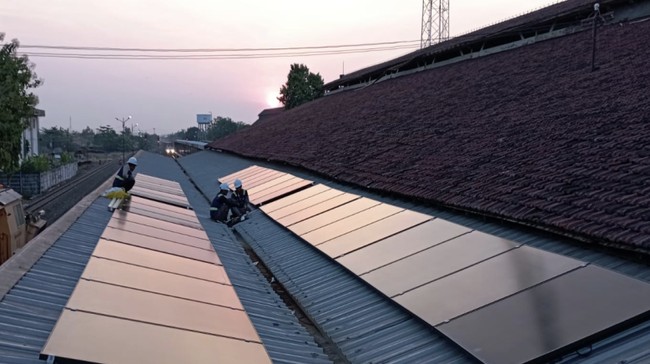
Jakarta, CNBC Indonesia - The utilisation of Solar Power Plants (PLTS) in Indonesia remains relatively low to this day, even though its potential is very large.
National Energy Council (DEN) member Sripeni Inten Cahyan revealed that the low utilisation of PLTS is not only influenced by efficiency factors but also by economic and technical constraints.
“So why is our utilisation so low? We’re not talking about efficiency which is around 20%, in subtropical countries it’s more than that. But the point is, this is local energy that we can optimise. The homework now is about economics. If we talk about economics, there are two aspects: economics and technical,” said Sripeni in Jakarta on Tuesday (21/4/2026).
According to her, developing the PLTS industry requires economies of scale so that costs can be more competitive while providing significant national economic impacts.
She explained that Indonesia currently has around 25 manufacturers with solar panel production capacity reaching about 5.8 GW per year. With that capacity, if relying solely on domestic production to achieve a large target like 100 GW, it would take around 20 years.
Even if production capacity reaches around 10-11 GW per year, the time required would still be about a decade. Therefore, a market division strategy between small-scale and large-scale projects is needed.
In addition to economic factors, technical factors also pose major challenges. The intermittent nature of solar energy requires a flexible electricity system supported by energy storage technology such as batteries.
She explained that the government has regulated the obligation to add batteries for PLTS. In addition, gas-based power plants such as Combined Cycle Gas Turbine (PLTGU) and Gas Turbine Power Plant (PLTG) are considered capable of quickly responding to fluctuations in electricity production from PLTS.
“What does that mean? It can immediately follow changes in the intermittency fluctuations from PLTS. So from the system side, that means we should strengthen it in Java first, which is already ready with its system. The hydroelectric plants (PLTA) are already there, the PLTGU and PLTG which are gas-based are already there. So the system is already strong,” she said.