
Indonesia's Steel Industry Develops Net Zero Strategy Without Compromising Competitiveness
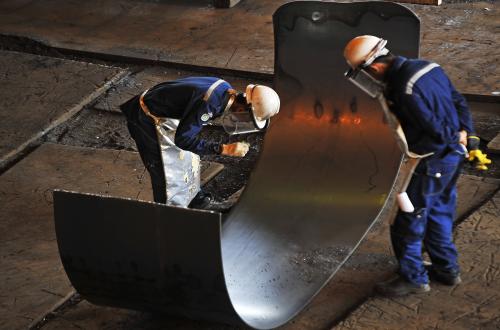
Global pressure to reduce carbon emissions is driving transformation in the national steel sector, long known as an energy-intensive industry. Industry players, academics, and policymakers are now seeking realistic pathways for transitioning so that the decarbonisation agenda progresses without disrupting business competitiveness.
The Net Zero Steel Pathways Cohort 2026 programme was held as an executive learning space to discuss strategies towards a low-carbon steel industry ecosystem in Indonesia. This three-month activity concluded with a grand final gathering featuring discussions on technology, policy, investment, and green industry implementation.
A total of 74 executives participated selectively in the programme, comprising around 7 percent top management and 15 percent senior leaders from the steel and energy sectors. Participants underwent four non-degree modules as well as strategic discussion forums with academics, industry players, and regulators.
Head of CPPM SBM ITB Yudo Anggoro stated that education is a key factor in accelerating readiness for the low-carbon steel industry ecosystem in Indonesia.
“Not many truly understand the complexity of this industry. Therefore, education through programmes like this is important to build readiness for the low-carbon steel ecosystem in Indonesia,” he said in a press release on Thursday (7/5/2026).
In an academic presentation, ITB Metallurgy Engineering lecturer Zulfiadi Zulhan explained that the global steel industry is under significant pressure to reduce emissions in line with international commitments towards net zero emission targets post-Paris Agreement.
The steel industry produces an average of around 2.4 tonnes of CO2 for every tonne of crude steel manufactured, making it a priority sector in the global decarbonisation agenda.
According to Zulfiadi, the most realistic transition pathway currently is a gradual shift from natural gas-based DRI + EAF to hydrogen-based DRI + EAF. However, fully hydrogen-based technology still faces challenges with high energy costs.
“Implementation of fully hydrogen-based technology is not yet economically competitive at present. The main challenge remains energy costs, particularly the relatively expensive use of natural gas,” he revealed.
Zulfiadi assessed that the national innovation ecosystem still faces limitations in information exchange and technology development speed, causing the innovation process to proceed more slowly compared to other countries.
From the industry side, Chief Operating Officer of PT Krakatau Steel Tbk Sidik Darusulistyo highlighted the steel sector’s dilemma in maintaining balance between decarbonisation targets and business sustainability.
He explained that the steel industry supports many national economic sectors but operates with relatively thin profit margins, making operational efficiency a determining factor.
Currently, the company is focusing on accelerating the cash conversion cycle, streamlining business processes, and strengthening the domestic supply chain to maintain profitability amid production cost pressures and global energy volatility.
Sidik also emphasised a market-driven production approach that relies on precision in production and delivery cycles to reduce inventory needs, although its implementation still faces field challenges. Digitalisation and the utilisation of artificial intelligence are seen as important accelerators in the steel industry transformation.
The Net Zero Steel Pathways Cohort 2026 programme concluded with the awarding of recognitions to participants, including categories for Best Learning Participant and Best Essay. This forum is expected to produce strategic recommendations to accelerate the development of low-carbon steel industry in Indonesia.