
Indonesia's Palm Oil Production Forecast to Drop 6%, Will the US's 0% Tariff Make a Difference?
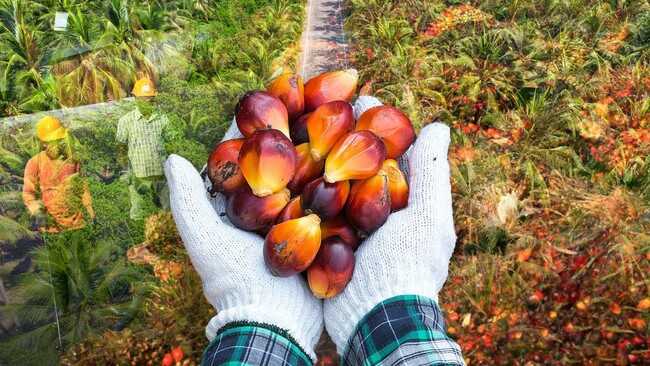
Jakarta, CNBC Indonesia - The Executive Director of the Indonesian Vegetable Oil Industry Association (GIMNI), Sahat Sinaga, views the United States’ (US) policy of setting a 0% import tariff for Indonesian palm oil as positive news for export performance.
However, this benefit comes at a time when the national palm oil industry is facing the threat of a production decline this year.
“If I say it’s good for us, then yes. But don’t forget that our production this year is likely to drop by 5 to 6 percent compared to last year,” said Sahat when met in Jakarta, Wednesday (25/2/2026).
According to Sahat, the production decline is triggered by two main factors. First, climate conditions affect the productivity of fresh fruit bunches (FFB) in several plantation areas. Second, the change in the status of palm oil land which is included in the forest area and then taken over by the government, so that it is no longer managed by farmers.
He believes that the takeover of the land has the potential to disrupt the continuity of production if it is not managed clearly.
“Will the continuity of production be guaranteed after it is taken over? Who guarantees it? Because farmers are not allowed to work on it. Now who will work on it? It needs to be found,” he said.
Sahat added that without strict supervision during the transition period, the risk of production decline will be even greater.
“With conditions like this, it is very likely that our production will drop. What will happen? A lot of theft because the owner has been blocked, no longer allowed to participate. This means the government has to take care of it. Is it being monitored?” he said.
Meanwhile, from the market side, the United States remains a destination for Indonesian palm oil exports. Sahat said exports to the Pacific Rim region, which includes the US, Canada, and Mexico, are in the range of 3.5-4 million tons per year, with the portion to the US being around 2.5-2.8 million tons.
However, Sahat reminded that the zero percent tariff does not automatically make Indonesia superior. This benefit can be eroded by high logistics costs, especially due to an inefficient distribution chain.
He cited the example of sending palm oil from Papua which still has to go through Jakarta before being exported to the US. Transportation costs from Papua to Jakarta reach around US$30 per ton, plus shipping costs to the US of around US$110 per ton. This figure is much more expensive compared to Malaysia which is only around US$90 per ton.
According to Sahat, this condition shows the need for the development of a processing industry that is closer to raw materials, especially in eastern Indonesia.
“Why not build a refinery and oleochemical in Papua? A capacity of 3 million tons per year is sufficient to make it an economically viable special economic zone,” he said.
In addition to Papua, Sahat believes that several industrial areas that have been developed are actually on the right track. One of them is the Maloy Batuta Trans Kalimantan Special Economic Zone, which he believes has a strategic advantage to serve the Asian market.
“Maloy is good. For northern Aceh, for what purpose, if Maloy exists, our exports to China, to China, Korea, Japan, will definitely be cheaper by about 10-12 dollars compared to Malaysia,” he concluded.