
Indonesia's Megathrust Zone Map Changes, Japanese Expert Highlights Hazard Areas
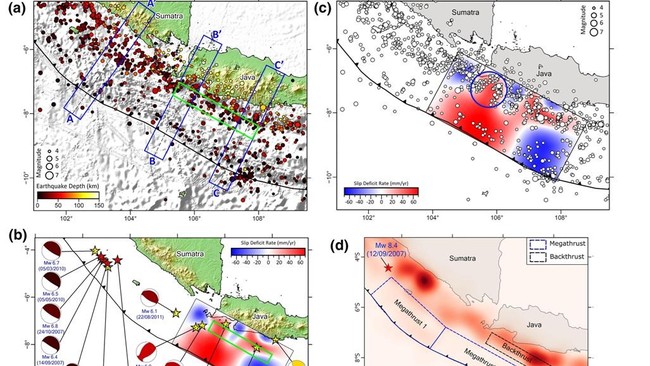
Jakarta, CNBC Indonesia – The 2024 Indonesian Earthquake Source and Hazard Map has recorded an increase in megathrust zones to 14 points. The latest map indicates higher potential hazard levels compared to the 2017 release, marked by increasingly dense hazard contours across several regions.
The increase in megathrust zones in Indonesia has also drawn attention from Japan. Professor Kosuke Heki from Hokkaido University believes Indonesia’s geological characteristics bear similarity to the Nankai Trough, one of the world’s most active megathrust zones.
“We understand that magnitude-8 earthquakes in Japan occur at intervals of approximately 50 to 100 years. This was our classical understanding before the occurrence of major earthquakes,” said Heki whilst serving as a Visiting Researcher at the National Research and Innovation Agency (BRIN), as cited on Sunday (15 March 2026).
According to Heki, whilst the timing of major earthquakes is difficult to predict, long-term monitoring of crustal deformation is essential for disaster mitigation. He emphasised the role of the Global Navigation Satellite System (GNSS) and seafloor geodetic measurements in reading stress accumulation in subduction zones.
“We observe seismic coupling that locks together almost along the entire trench axis. Even in very shallow plate boundary zones, strain continues to accumulate for the next earthquake,” he explained.
Heki also highlighted the phenomenon of slow slip events, which often occur before major earthquakes. Despite moving very slowly, this phenomenon is considered a potential early indicator.
“This phenomenon has been observed repeatedly at the Nankai Trough and other regions in Japan. One of these slow slip events could potentially trigger the next major earthquake,” he said.
He believes Indonesia has significant opportunities to develop a similar monitoring system, given the numerous active subduction zones stretching from Sumatra, Java, Bali, Lombok to Maluku. By strengthening GNSS networks and seafloor monitoring technology, Indonesia is considered capable of reading tectonic stress accumulation more precisely.
“I am currently working on this issue in Indonesia,” said Heki.
In the latest map, the Aceh-Andaman Megathrust is recorded as having the largest earthquake potential with a maximum magnitude reaching 9.2. Meanwhile, the Java Megathrust has the potential to trigger earthquakes up to magnitude 9.1. Several other zones such as Mentawai-Siberut, Mentawai-Pagai, and Enggano each hold earthquake potential up to magnitude 8.9.
The Meteorological, Climatological, and Geophysical Agency (BMKG) previously also highlighted the existence of two megathrust zones still in seismic gap condition, namely the Sunda Strait and Mentawai-Siberut. Both regions have not released significant energy for hundreds of years, each since the last earthquakes in 1757 and 1797 respectively.
BMKG emphasised that the term “waiting for time” is not intended as a prediction of when earthquakes will occur.
“What is meant is the accumulation of energy that remains stored because no major earthquakes have occurred for a long time. This does not mean earthquakes will happen in the near future,” BMKG stated in its official statement.