
Indonesia's Islamic Economy: A System in Place, But Not Yet a Culture, Says Ma'ruf Amin
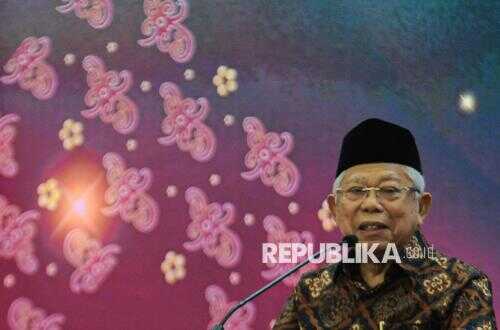
REPUBLIKA.CO.ID, JAKARTA – The 13th Vice President of the Republic of Indonesia and Chairman of the Advisory Council of the Center for Sharia Economic Development (CSED) Indef, Ma’ruf Amin, has criticised the Islamic economy in Indonesia, stating that it has developed into a system. However, according to him, the Islamic economy has not yet grown and developed as a culture.
This was conveyed by Ma’ruf when delivering a speech at the 99 Indonesian Islamic Economists Sarasehan 2026 event at the Bank Mega Tower, Jakarta, on Tuesday (24/2/2026). Ma’ruf said that Indonesia’s potential as a global centre for Islamic economy is actually very large. However, he acknowledged the need for extra effort in strengthening the Islamic economic ecosystem.
“Indonesia has all the requirements to become a centre for Islamic economy in the world. We have the largest Muslim population in the world, a large real sector, especially SMEs, and also the largest Islamic philanthropy through zakat, infaq, sadaqah, and waqf. We have relatively good economic and political stability,” said Ma’ruf.
According to Ma’ruf, Indonesia should be grateful because the Islamic economy in Indonesia has shown significant progress. Several important indicators show this progress. First, Indonesia occupies a strategic position in the global halal economy, ranking third according to the State of the Global Islamic Economy (SGIE) 2024/2025 report.
Second, national Islamic financial assets also continue to increase with stable growth each year. Data shows that the total assets of the Islamic financial sector reached IDR 9,927 trillion at the end of December 2024.
Third, the halal industry continues to grow and develop, from halal food, Muslim fashion, to halal tourism. Fourth, the management of zakat and infaq is becoming more organised and has great potential as an instrument of economic redistribution.
“However, we must also honestly acknowledge a reality, that the Islamic economy has grown as a system but has not yet fully taken root as a culture. It has become a system, but it has not yet grown into a culture,” said Ma’ruf.
“It is present in regulations, but not yet fully present in awareness. It is present in institutions, but not yet fully present in behaviour. So the contribution of the Islamic economy in this country is still not significantly felt. This is our historical challenge,” he continued.
Ma’ruf explained that the struggle for Islamic economy has two major agendas. First, to popularise Islamic economy, namely to make Islamic economy known, understood, and accessible to all people.
According to him, the first agenda has been achieved. This is in line with the birth of the Islamic Economic Movement (Gres) which has been initiated since 2000.
The second major agenda of Islamic economy is to Islamise the community’s economy, namely to ensure that the community’s economic practices use Islamic economic principles that truly reflect the values of justice, trustworthiness, and benefit.
“This second agenda, Islamising the community’s economy, still requires more effort to realise it,” he explained.