
Indonesia's Intention to Mediate the War, Iranian Ambassador: No Negotiations
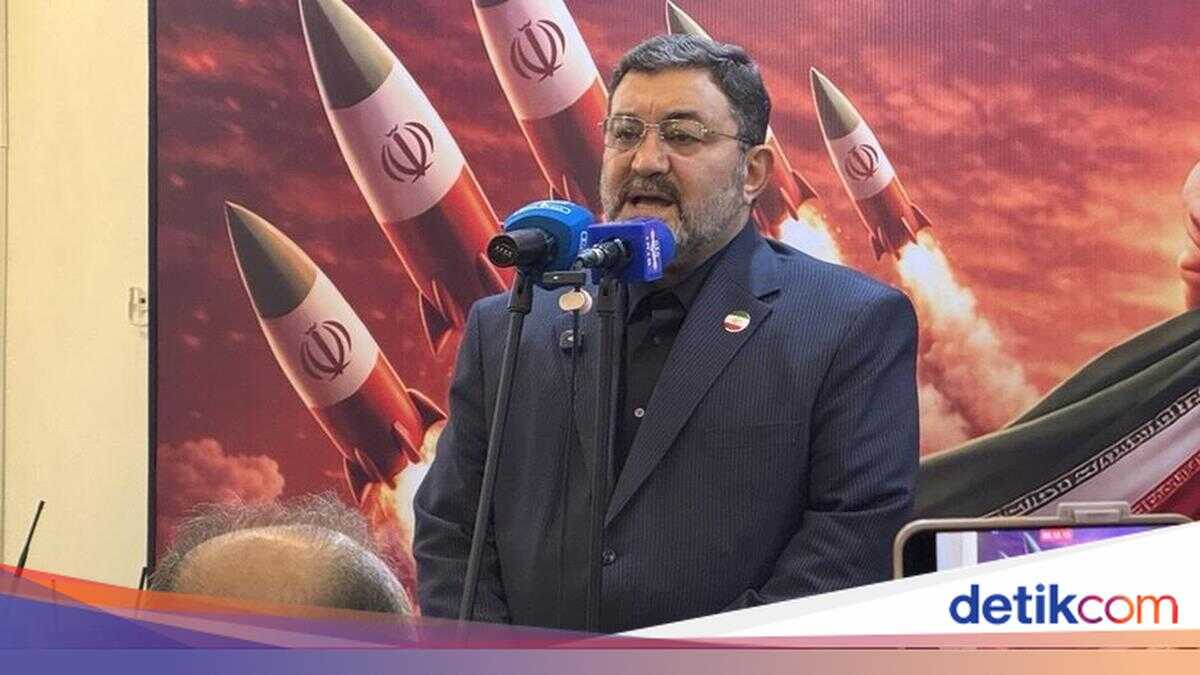
We certainly express appreciation for the message and readiness (mediation) conveyed by Indonesia, but for us, there is no negotiation with the country that has launched hostility against us, namely the United States (US).
That statement was delivered by Mohammad Boroujerdi, the Ambassador of the Islamic Republic of Iran to Indonesia, in response to Indonesia’s readiness to mediate the US–Israel war with Iran.
At a press conference held after the death of Iran’s Supreme Leader Ali Khamenei in an attack allegedly carried out by the US and Israel on Monday (02/03), he emphasised that there is no guarantee the United States will adhere to a deal. According to him, mediation is no longer a solution.
Indonesia proposes mediation of the US–Israel war with Iran.
Previously, the Indonesian government stated its readiness to travel to Tehran if needed to mediate between the United States and Iran. Through a post by the Indonesian Foreign Ministry (@Kemlu_RI) the government regrets the breakdown of negotiations between the US and Iran that led to military escalation. In this regard, Indonesia also urged all parties to pursue peace through dialogue and diplomacy. ‘The Government of Indonesia, in this case the President of the Republic of Indonesia, reiterates readiness to facilitate dialogue to restore secure conditions,’ posted by @Kemlu_RI on platform X on Saturday (28/02).
Experts: Indonesia has no bargaining power
In response to Indonesia’s mediation intentions, several experts and figures assessed that Indonesia is not in an ideal position to be a peacemaker in this war. ‘That’s all—we are not on equal terms with America. How can we reconcile with someone who is not equal in such negotiations?’ asserted Jusuf Kalla, former Vice President of Indonesia.
This view aligns with M. Waffa Kharisma from the Centre for Strategic and International Studies (CSIS). ‘Indonesia has no leverage in this conflict, and its dynamics are still highly heated and escalatory, making it harder to call for calm and de-escalation,’ he said.
According to Waffa, what matters more for Indonesia now is not to join the escalation but to prepare for the further impacts. Indonesia needs to focus on strengthening resilience so as not to be easily hit by cascading effects that may occur.
Similarly, Yusli Effendi, a lecturer in International Relations at Universitas Brawijaya, assessed that the most realistic step is to strengthen protection of national interests. One crucial aspect is anticipating an increase in oil prices so that the impact on the economy and society can be mitigated. ‘The spike in oil prices due to the conflict, especially if the Hormuz Strait is disrupted, will directly affect subsidies and the budget deficit,’ Effendi said.
The dilemma of determining a stance.
According to Waffa, whatever stance Indonesia voices now is unlikely to be difficult to immediately ease the conflict, particularly because the attack dynamics are ongoing. He also reminded that from an international perspective, Iran often faces scrutiny regarding its domestic governance, seen as repressive of its people. This condition makes Indonesia’s room for maneuver limited, because too explicit support risks being seen as taking the side of the wrong party.
Nevertheless, Waffa stressed that attacks that cause civilian casualties cannot be justified. Therefore, Indonesia is still considered to need to condemn actions that violate humanitarian principles. ‘The most that can be done is to condemn the aggression because it is unwarranted and triggered by hysteria,’ he emphasised.
Meanwhile, Effendi sees another risk if Indonesia chooses a passive stance of neutrality. In his view, on the global stage, perception carries as much weight as a country’s formal position. ‘Geopolitically, Indonesia risks losing credibility. The US could see Indonesia as less cooperative, while Iran and BRICS+ partners could regard Indonesia as too subservient to Western pressure,’ he said.
Therefore, Effendi assessed that Indonesia should still demonstrate a measured stance, given the real economic impacts. Clarity of position, he said, could help Indonesia maintain bargaining power, including in securing alternative energy supplies and protecting exports. ‘Ultimately, the most crucial thing is to ensure Indonesia remains consistent with the principle of free and active foreign policy, maintain domestic stability, and safeguard national interests amid global geopolitical shifts,’ he concluded.
What happened in Iran?
It is known that the US–Israel conducted a preemptive strike on Saturday (28/02) on Tehran; Iran killed Supreme Leader Ali Khamenei. The death of the 86-year-old leader who had ruled since 1989 was confirmed by Iranian state media. The attack also killed several senior Iranian officials, including members of Khamenei’s family and senior IRGC leaders. Tehran said it would retaliate against Israel and US military bases in the Middle East.
The attack targeted at least Al-Udeid Air Base in Qatar, Al-Salem Air Base in Kuwait, Al-Dhafra Air Base in the United Arab Emirates, and the US Fifth Fleet base in Bahrain. The IRGC said it would begin ‘the most devastating offensive’ in Iran’s military history. Meanwhile, Iranian President Masoud Pezeshkian stated that Iran would continue ‘to destroy’ enemies. ‘The Armed Forces of the Islamic Republic of Iran act with power to destroy enemy bases, and they will continue to take action and disappoint enemies, as they always do,’ he said.
(ita/ita)