
Indonesia's Electricity Supply Plan (RUPTL) to Be Revised Again, Here's Why
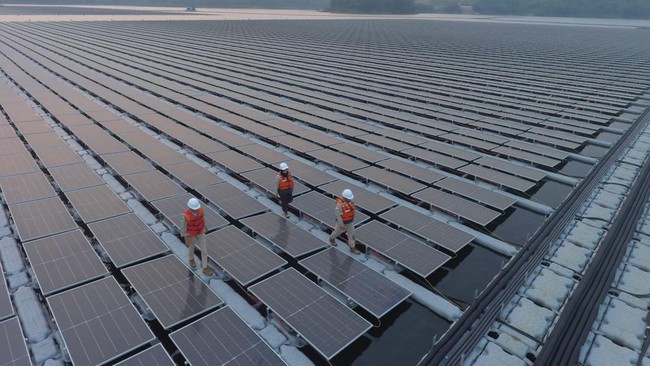
Jakarta, CNBC Indonesia - The Ministry of Energy and Mineral Resources (ESDM) plans to revise the Electricity Supply Business Plan (RUPTL) 2025-2034, which was only launched last year.
Acting Director General of Electricity at the Ministry of ESDM, Tri Winarno, said the government is currently discussing several adjustments to the RUPTL.
“There are indeed some corrections to the RUPTL, something like that. So we’re conducting discussions,” Tri said at the RI House of Representatives building, quoted on Thursday (16/4/2026).
Tri added that the revision is fundamentally aimed at making the national electricity planning more adaptive to the dynamics of needs and regulatory changes.
“As I mentioned earlier, the point is to make the regulations as adaptive as possible, something like that,” he stated.
As is known, Minister of Energy and Mineral Resources Bahlil Lahadalia officially launched the Electricity Supply Business Plan (RUPTL) of PT PLN (Persero) for the 2025-2034 period.
According to Bahlil, the preparation of the RUPTL 2025-2034 involved a lengthy discussion process and was thoroughly reviewed. He hopes the results will be precise and meet the needs.
“So our RUPTL is already in line with the RUKN and KEN; this is like the RUKN is the law, the KEN is the government regulation, and the RUPTL is the spirit. This is the reference tree from which the RUPTL is born so that we don’t stray from the framework,” Bahlil said at a press conference at the Ministry of ESDM building on Monday (26/5/2025).
In the RUPTL, the addition of power plant capacity is targeted to reach 69.5 Gigawatts (GW). This consists of 42.6 GW from new and renewable energy (EBT) power plants.
Then 10.3 GW will come from energy storage systems, while 16.6 GW will come from fossil fuel-based power plants.
The details for EBT power plant capacity are as follows: Solar at 17.1 GW, Hydro at 11.7 GW, Wind at 7.2 GW, Geothermal at 5.2 GW, Bioenergy at 0.9 GW, and Nuclear at 0.5 GW.
Meanwhile, the energy storage system capacity includes pumped storage hydro at 4.3 GW and batteries at 6.0 GW. For fossil fuel power plants, 16.6 GW will still be built, consisting of gas at 10.3 GW and coal at 6.3 GW.