
Indonesia's Economy Grows 5.61%, Airlangga Ensures MBG as a Driver
Indonesia’s economy grew by 5.61% in the first quarter of 2026, exceeding the government’s projection of 5.5%. This growth was propelled by strong public consumption and various priority government programmes, including the free nutritious meals (MBG) initiative.
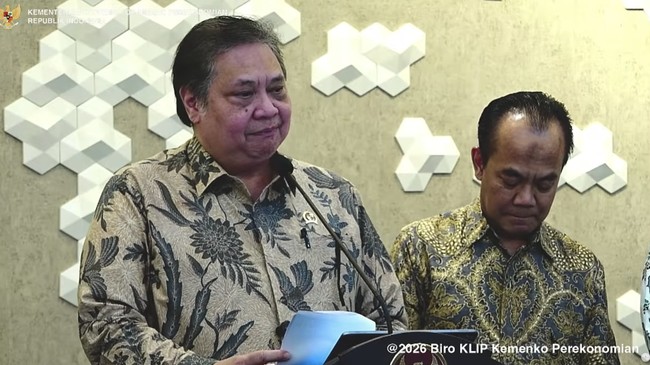
Coordinating Minister for the Economy Airlangga Hartarto stated this during a press conference at the Coordinating Ministry for the Economy office in Jakarta on Tuesday (5/5/2026).
Airlangga explained that the current economic growth is inseparable from various government policies and the occurrence of major religious holidays. The effects of these policies also influence public consumption, which serves as a key driver of Indonesia’s economic growth.
“We see that household consumption remains the primary driver with growth of 5.52%, which further confirms that the momentum from Ramadan and Eid al-Fitr, as well as the high increase in mobility, has boosted it,” Airlangga clarified.
Additionally, government spending, which grew by 21.81% in the first quarter of 2026, was also cited by Airlangga as a lever for the national economy.
“In the first quarter, we also see government spending growing high at 21.81%, where this figure is around Rp815 trillion. This is above the historical average,” Airlangga said.
The government programmes contributing to this growth, according to Airlangga, include spending by ministries and agencies, such as the free nutritious meals (MBG) programme, with a realisation of Rp51 trillion up to March.
Furthermore, stimuli from fare discounts and Eid al-Fitr bonuses (THR) for civil servants (ASN) realised at Rp51.65 trillion, as well as THR from the private sector and to online motorcycle taxi drivers.
“Over the first three months, various government stimuli and policies have been able to drive growth and serve as a buffer against the impact of global turbulence, one of which is transportation fare discounts during Eid al-Fitr: economic class train passengers rose by 7.6% year-on-year, sea transport up 2.56% year-on-year, ferry transport up 13.7% year-on-year, and subsidy realisation of Rp169 billion.”
Airlangga then outlined the latest economic indicators and their positive prospects, with inflation in April at 2.42%, returning to the target range of 2.5% plus or minus 1%. The consumer confidence index stands at 122.9, and the trade balance is in surplus for 71 consecutive months.
Meanwhile, from the credit growth position, third-party funds increased by 13.55% year-on-year, and credit growth was 9.49% year-on-year.