
Indonesia's Dilemma in the Board of Peace (BoP)
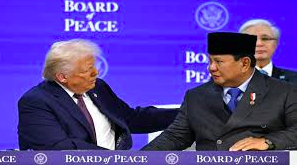
Indonesia’s accession to the Board of Peace (BoP) forum is seen to still leave a number of technical and political issues, especially after the escalation of tensions in the Middle East following the US and Israel military strikes against Iran. The government is believed to need to tread carefully before moving further in its commitment.
Broto Wardoyo, a lecturer in International Relations at Universitas Indonesia, assesses that the main problem in Indonesia’s involvement in BoP lies in the technical mechanisms which are not yet clear. According to him, big agreements such as reconstruction of conflict areas or deployment of peacekeeping troops have not been accompanied by adequate operational details. He cites fundamental questions that are yet to be answered, such as weapons disarmament mechanisms and who will run the operations on the ground. Without such clarity, involvement of participating countries could pose new risks. According to him, technical ambiguity could trigger clashes on the ground if troops from various countries are deployed without a clear coordination mechanism.
“Details, for example, talk about disarmament, what is the mechanism, who will do it, will it be us, Indonesia? Or will it be Egypt, or who else,” he said when contacted on Thursday (5/3).
Moreover, the plan for reconstructing conflict areas is still very abstract. From determining the location of reconstruction to who is responsible for clearing debris after the war, these have not been explained in the agreement. Broto believes Indonesia should not rush to send troops before all those details are agreed clearly. “It’s not possible that we get involved and then send troops, but we still don’t know. What the government has provided thus far is that we will focus on humanitarian aspects, but how, whether we will only guard borders, or protect medical convoys, for example,” he explained.
On the other hand, he regards Indonesia’s political decision to join the forum as a move taken essentially by President Prabowo Subianto. However, constitutionally, the implementation of international agreements still requires a domestic political process, including possible approval by the House of Representatives if the agreement is in the form of a treaty.
Besides technical and domestic political aspects, Indonesia’s involvement in BoP is also related to international reputation. So far, participation in the forum has been seen as a move to show Indonesia’s active role in global peace processes. However, current geopolitical conditions require re-evaluation of that calculus. Broto sees that the government should carefully consider field risks if Indonesia sends troops without a clear mandate and operational mechanism.
“If the details are not yet clear, then don’t rush. Because what we are considering is sending a large number of troops, and if later there is clear uncertainty, for instance if there are armed clashes, not to mention if casualties occur, that’s the hard part,” he said.
Regarding the idea of using Indonesia’s BoP membership as a diplomatic bargaining chip to ease conflicts, Broto says the step is possible but not risk-free. “Actually, if we think in the context of de-escalating tensions, negotiation itself is more effective. If BoP cards are to be used as a bargaining tool, that could indeed happen,” he added.
But he reminded that withdrawing from a signed agreement can also have diplomatic consequences. “The problem is when we have signed an agreement and then decide to withdraw, there are risks. So it’s a case of pluses and minuses,” Broto said.
He argued that a more realistic approach is to use Indonesia’s diplomatic ties with various parties to open lines of communication, including with the United States, Iran, and Israel. Mediation efforts, he said, are not easy because they require a deep understanding of the interests of each conflicting side. “At least we can talk to them; this (the Iran situation) is a concern. But to reach that, we also need to know what Trump’s aims are, what Iran wants, and what Israel wants,” he added.
In the end, Broto assesses that Indonesia’s position today is indeed not straightforward. Every option, whether to continue involvement or withdraw, carries political consequences. “We are in a dilemma. If we withdraw there will be political costs to bear, if we proceed there will also be political costs to bear. So this also depends on the president, which is more confident,” he concluded. (Mir/P-3)