
Indonesia's 'dead river' a stark warning after Sumatra flood disaster
Indonesia’s ‘dead river’ a stark warning after Sumatra flood disaster
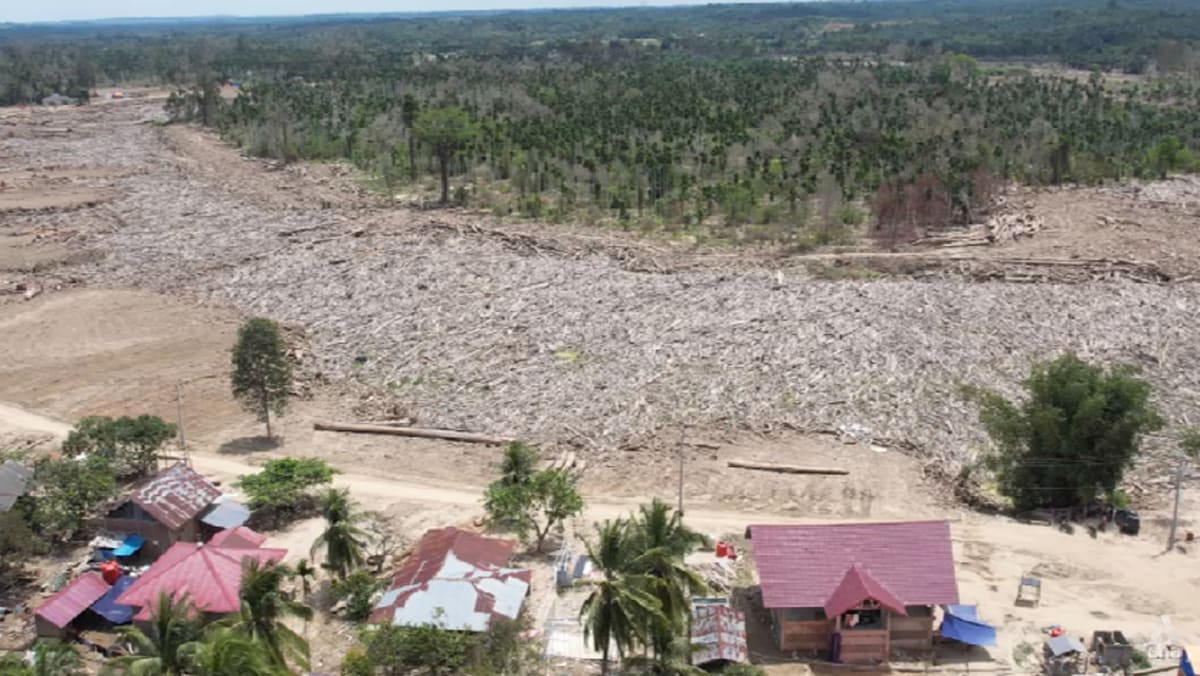
A river clogged with timber in North Aceh has become a symbol of how deforestation and extreme weather collided.
NORTH ACEH, Indonesia: Months after Cyclone Senyar triggered deadly floods across Sumatra, a river in North Aceh remains buried beneath a thick layer of timber.
Residents now call it the “dead river”.
Water still flows beneath the vast carpet of floating logs, but from above it looks lifeless – choked by debris left behind when floodwaters surged through the region last November.
Many of the logs show clean, flat chainsaw cuts – suggesting they were felled rather than naturally broken.
During floods, timber like this can be swept downstream and act like battering rams, slamming into homes and infrastructure with destructive force.
Cyclone Senyar brought days of intense rainfall to western Indonesia, but the scale of devastation cannot be attributed to heavy rain alone.
Widespread deforestation in forests upstream had stripped away natural cover, turning heavy rain into fast-moving, destructive currents.
WHEN FORESTS DISAPPEAR
Forests act as natural protection against floods and landslides. Tree canopies soften the impact of heavy rain while roots absorb water and anchor soil in place.
When trees are cleared, that protection disappears.
Without roots to hold the soil, rainwater rushes quickly across barren land, swelling rivers downstream. Loose soil mixed with massive volumes of water increases the risk of landslides.
In Sumatra, the water also carried tonnes of timber straight into villages.
Rustam Abdullah Hassan, 50, a resident of Geudumbak village in North Aceh, remembers rushing his family to safety as floodwaters rose. When he returned, there was nothing left to salvage.
“My house wasn’t washed away – it was smashed by logs that tore through homes in our area. The logs were swept into the river, then piled up and crashed into nearly 400 houses,” he said.
GOVERNMENT’S RESPONSE
The link between forest loss and flooding has since come under national scrutiny.
Speaking at the World Economic Forum’s annual meeting in Davos in January, President Prabowo Subianto said his administration had ordered a sweeping environmental audit and revoked the licences of 28 corporations covering more than 1.01 million hectares of land.
The 28 companies span various industries, including forestry, palm oil, cocoa, mining and power generation.
The Attorney General and the Criminal Investigation Agency are also developing cases for potential criminal prosecution against the companies.
“We found them violating laws. They were building plantations on protected forests. This is a flagrant undermining of the rule of law,” he said.
The government said the cancelled land permits will be placed under the management of the state’s sovereign wealth fund, Danantara – a move it said will centralise and strengthen green economic management.
But critics argue the plan risks concentrating even more power in state hands.
Nabhani Yustisi, executive director of the Aceh Environmental and Human Rights Advocacy Institute, said placing the land under a state investment body may not change its purpose.
“Danantara was created to generate profit for the state. Its purpose is economic. So if these concessions are transferred and managed again for profit, what difference does that make?” he said.
“What we want is for the land to be turned into protected forest – a special zone no longer used for economic interests,” he added.
REPLANTING AND RECOVERY
In February, authorities launched the Indonesia ASRI (safe, healthy, clean and beautiful) movement, a national initiative aimed at strengthening environmental management and public participation.
Local officials say reforestation is a key part of that effort, especially in areas left vulnerable by forest loss.
Jamaluddin, regional secretary of North Aceh – who like many Indonesians goes by one name – said reforestation efforts are crucial to reducing future risks.
“Replanting trees in cleared and barren areas is vital. Communities are also rolling out programmes like ASRI to replant trees in residential areas, creating natural protection. In short, it’s a form of mitigation.”
Jamaluddin added that the local government is conducting outreach to communities to discourage illegal logging, and to other stakeholders to jointly preserve these forests.
In Geudumbak, residents and volunteers are working to clear the timber clogging the river. Some of the salvaged wood is being reused to build temporary homes for displaced families.
The local administration also said it is involving industries that can process the material into pressed wood or use it in furniture production.
But concerns remain over the massive amount of logs still left in the river.
Rendy Kombih, coordinator at humanitarian organisation Rumah Zakat, said the danger has not passed.
“It has already become a dead river, though water still flows beneath the timber. Residents say flooding happens here almost every year. So when the water rises again, the logs will float back up,” he said.
“That’s the fear – that one day they could surge through homes once more.”
For the people of North Aceh, the clogged river is a visible reminder of how unchecked exploitation can turn extreme weather into catastrophe.