
Indonesia's Cocoa Imports Surge, The Problem is Indeed Complex
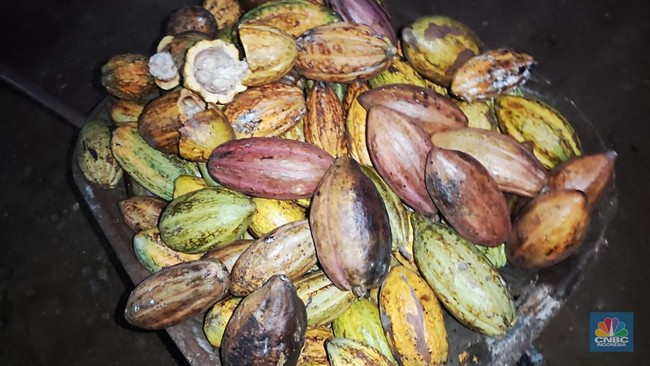
Indonesia’s dependence on imported cocoa has been spotlighted by President Prabowo Subianto. Behind Prabowo’s spotlight, there are structural issues in Indonesia’s cocoa industry and agriculture, ranging from shrinking land areas, stagnant exports, and a surge in imports.
In a discussion with journalists and economists at his residence in Hambalang, Bogor Regency, West Java, Prabowo questioned the phenomenon of substantial cocoa imports.
Indonesia is estimated to import cocoa worth US$1.1 billion per year despite being capable of producing 600,000 tonnes annually. Data from the Central Statistics Agency (BPS) shows even higher imports. The shrinking land area is one of the contributing factors.
Vast Land, But Starting to Shrink
Over the past two decades, data on the area of cocoa plantations in Indonesia recorded by BPS shows an unstable trend. After reaching its peak around 2012 with an area of more than 1.7 million hectares, this figure has continued to decline to around 1.36 million hectares in 2024.
This decline reflects classic problems in the plantation sector, such as minimal replanting which leads to low plant productivity.
Interestingly, more than 90% of cocoa gardens are managed by smallholder plantations. This signals that the main challenges lie at the small farmer level.
Stagnant Exports, Imports Increasingly Dominant
From a trade perspective, Indonesia is still recorded as a cocoa exporter. However, upon closer inspection, the volume tends to stagnate in the range of 330-609 thousand tonnes over the past 20 years.
In contrast, imports show a much more aggressive trend, especially in 2014 when cocoa imports surged sharply by 121.6% from 2013 imports. Even in 2023, the import volume nearly matched exports with a difference of just 462 tonnes, marking a critical point where Indonesia almost lost its status as a net exporter.
Nevertheless, the cocoa exported by Indonesia consistently has a slightly higher price compared to imported cocoa.
Based on the calculation of value against volume, the price of Indonesian cocoa exports from 2003-2023 ranged from US$1.4-US$3.7 per kg, with an average of around US$2.8 per kg.
Meanwhile, the price of imported cocoa ranged from US$1.5-US$4.0 per kg, with an average of around US$2.66 per kg.
In 2024, both export and import prices experienced significant surges to around US$7.6 per kg and US$6.1 per kg, respectively, reflecting global pressures in the cocoa market.
The high price of Indonesian cocoa indicates that its position in the global value chain is still supported by product quality. However, the increase in imports with prices approaching export prices indicates vulnerability in that competitiveness.
From Producer to Import-Dependent?
The latest data reinforces this shift. In 2025, Indonesia’s cocoa imports reached nearly 195 thousand tonnes with a value of US$1.7 billion or around Rp28.7 trillion. The main supply comes from major producing countries such as Ecuador and West African regions.
This phenomenon shows that although Indonesia is still strong in the upstream sector, its position lags in processing and control of the end-product market.
On the other hand, the domestic market is flooded with chocolate products and processed goods from global brands. This confirms that the greatest added value is not enjoyed domestically, but in processing countries.