
Indonesia's Car Exports to the Global Market: Evidence of an Increasingly Value-Added Industry
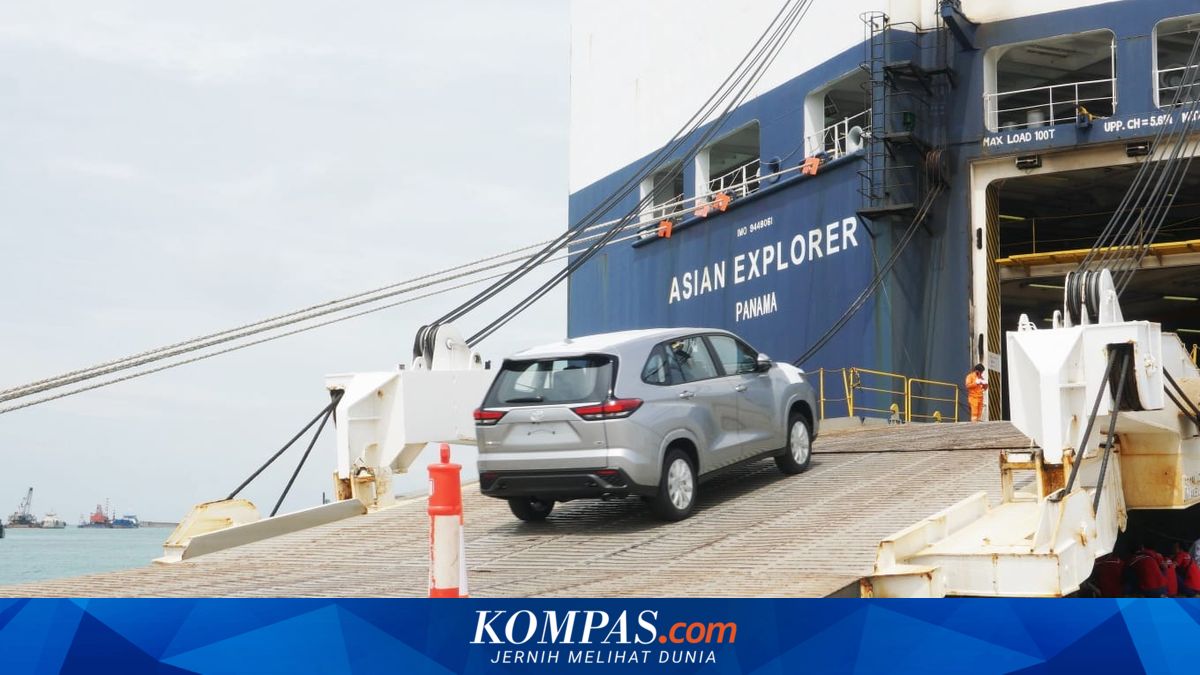
The Indonesian four-wheeled vehicle industry is no longer merely known as a production base. The ability to ship locally produced cars to various countries demonstrates that national automotive products have met the quality demands, technical specifications, and supply consistency required by the global market. In the automotive industry, exports are not just about selling abroad. Behind it lies the capability to maintain production standards and supply chains to remain stable amid market dynamics. Exports of complete vehicles run parallel to the performance of spare parts exports, forming a more comprehensive automotive industry ecosystem, from tyre suppliers, wiring, to other components integrated into the global supply chain network. Exports are often viewed as one indicator of the automotive industry “upgrading” because not all production bases can penetrate foreign markets. In practice, exports demand industrial discipline, from unit-to-unit quality consistency, production capacity stability, and a strong supply chain to ensure shipments are not disrupted. One of the main prerequisites for exports is consistent quality. Citing the British Standards Institution (BSI) website, in the global automotive supply chain, many manufacturers and suppliers refer to quality management standards such as IATF 16949. This becomes one of the important foundations for entering international markets. In addition to quality, export capability also serves as a marker of local manufacturing supply chain resilience. Citing the OECD Statistics website on Thursday (6/11/2025), the automotive industry relies on an extensive supply chain. Therefore, production capacity stability and supply resilience are crucial to prevent export shipments from being disrupted. Furthermore, exported products have also met compliance with the specifications and technical regulations of the destination countries. In global motor vehicle trade, every produced vehicle model must comply with technical regulations, safety standards, and applicable testing procedures in each market. This means that vehicle exports always intersect with meeting technical regulations, standards, and testing or certification procedures (conformity assessment) in the destination countries. At the trade level, aspects of standards, technical regulations, to testing or certification are also related to the WTO Technical Barriers to Trade (TBT) framework. This framework regulates voluntary standards, mandatory technical regulations, and conformity assessment procedures, including testing or certification, to ensure products meet applicable standards or regulations. In other words, exports are not merely about shipping products abroad. Rather, they represent the impact of an industry capable of maintaining quality, capacity, and standard compliance repeatedly, supported by a supply chain that can keep up with production rhythms. In recent years, exports of completely built-up (CBU) four-wheeled vehicles from Indonesia have moved dynamically, following post-pandemic market recovery, automaker production rhythms, and demand from destination countries. Based on data from the Coordinating Ministry for the Economy, CBU four-wheeled exports were at 332,004 units in 2019, then dropped during the pandemic to 232,175 units in 2020, before rising again to 294,639 units in 2021. A surge was seen in 2022 when exports reached 473,602 units. Then, they rose again to 505,134 units in 2023 and remained at a high level of 472,194 units in 2024. From that number, the brand that was the main export contributor throughout 2025 was Toyota with a total of 298,457 units or about 58 percent. As reported by Kompas.com on Thursday (9/10/2025), Toyota has started exporting complete vehicles since early 1987. By the end of 2025, Toyota has officially exported more than 3 million domestically produced vehicles to various countries around the world. Toyota Indonesia has exported vehicles to more than 100 countries in Asia, the Middle East, Africa, Latin America, to Oceania. Some flagship models exported include the Kijang Innova, Fortuner, Avanza, and Raize. The automotive export capability does not stop at complete vehicles; Indonesia also produces and exports quality completely knocked down (CKD) vehicles to various countries. Meanwhile, in the vehicle component sector, Gaikindo recorded that Indonesia exported 153,075,695 pieces in 2024 and 141,912,643 pieces in 2025. Although experiencing a decline of around 7.3 percent in volume, the value actually increased. Data from the Indonesian Automotive Parts and Components Industries Association (GIAMM) in July 2025 shows that the value of Indonesian component exports in 2024 reached about $7.5 billion, while component imports were around $6.9 billion. This achievement indicates that when Indonesian-made components enter major markets, including Japan and the US, domestic suppliers begin to connect with global production networks. This also simultaneously creates added value from manufacturing activities and supply chains domestically. Behind the good export news, the four-wheeled industry still has major homework. GIAMM highlights that the value of component imports is highly dependent on production figures. When production rises, component needs also rise, and imports are driven if localisation capacity is not yet strong enough. This aligns with GIAMM data stating that the overall local content of Indonesia’s four-wheeled industry is around 55 percent. On the other hand, GIAMM also highlights weaknesses in Indonesia’s automotive manufacturing in high-tech components and raw materials, infotainment or communication, to certain raw materials. This is what makes some industry needs still require imports, especially for high-value components. The next challenge comes from electrification dynamics. In a presentation by GIAMM at the GIIAS 2025 event, imports of CBU tend to increase due to the electric vehicle (EV) programme which correlates with the 0 percent import duty scheme.